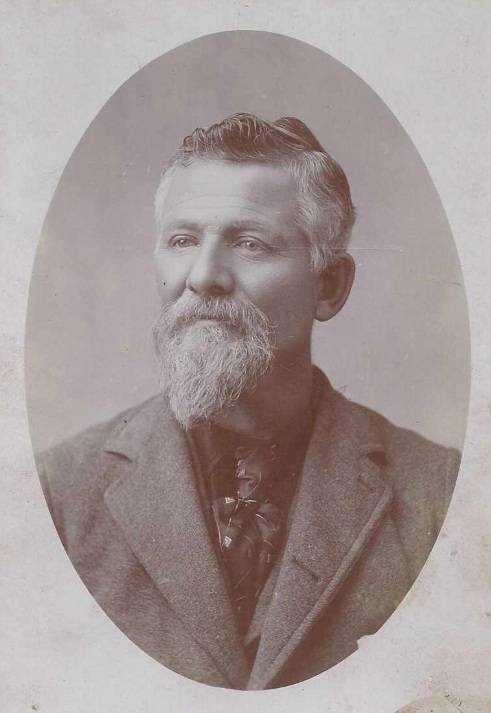
William Harrison Homer
By R. M. H. CROCKETT
William Harrison Homer, the fifth child of Russell K. and Eliza Williamson Homer, kept a diary for over fifty If years of his lifetime. It is deemed proper, in delineating his history, to quote directly from a short autobiography which he wrote, taking most of the material from his diary.
“I was born July 13, 1845, while my parents were travelling westward through the United States from Pennsylvania to
Iowa. My first memories are of living in Iowa among the Pottawattamie Indians, my playmates being Indian children. When I was six years old, father moved the family back to Pennsylvania to settle his father’s estate. We stayed there one year, and returned to Iowa where we lived for several more years.
“In the year 1858, our family started across the Plains for Salt Lake City. Father was the captain of the emigrant wagon train. Although I was a mere boy of 12, it was my job to drive a herd of cows across the Plains, which I did,
missing only three days on the entire journey because I had been struck by lightning.
“”This trip was certainly an eventful one in a boy’s life. We met many different tribes of Indians on the way. They always seemed fearfully hostile to me at first appearance, but my father had such a way with him that after he treated with them, usually presenting them with something of value, either beads, trinkets, or flour and tobacco, which he had along for the purpose, we were allowed to go along without further trouble. At the crossing of the Green river, we camped near the tents of the famous scout and trapper, Jim Bridger. With my father, I visited that illustrious man’s tents, saw his Indian wives, and played with his children while father traded horses with them.
“We arrived in Salt Lake City, October 7, 1858, and camped in a street in the Second Ward. It was just at the time that many families who had moved out on account of Johnson’s Army invasion were returning to their homes. We spent that winter in the Seventeenth Ward. In the spring, we moved to the Second Ward, where we lived for a number of years. “
“My father and my older brother Edmund returned to Iowa to help in freighting across the Plains, leaving me home to take care of the stock and the chores. My first seven years in Utah were spent principally as a cowboy, ranging cattle from Black Rock at the south end of Salt Lake, as far south as the Tintic mining district near Eureka. In July, 1860, 1 made my first trip to cache valley in northern Utah. With father, mother, and my baby brother, Russell K., Jr., I went to Smithfield to visit my married Sisters, Nancy Harris and Anna Lemon, who were among the pioneers of that locality. While on that trip, I was called to be one of the relay riders to carry the Governor’s message to the northernmost part of Cache Valley. This took me to Franklin, the oldest white settlement in the state of Idaho.
“I lived for some time in Smithfield. In 1866, I was called by the Bishop of Smithfield to drive ox teams as far east as the Missouri River to assist in bringing poor emigrants across the Plains.
Our company had a very hard trip, but it was one of the most memorable experiences of my life. We managed to get home in the fall, hale and hearty.
“May 1, 1867, I started on a mission to Great Britain. I labored alone in Warwickshire
Conference for eleven months; then I was appointed President of the Leicestershire Conference where I labored during the rest of my stay in England. There were a number of Saints coming to America on the S. S. Minnesota. I was made assistant captain of the company on the return voyage. After landing in New York, I left the company and went to visit my father’s people in Pennsylvania. I visited there for six weeks before resuming my journey. One of my cousins, James O. Crockett, went with me. We stopped to visit the Mormon Temple in Kirtland, Ohio. We there met Martin Harris, one of the witnesses of the divinity of the Book of Mormon. experience is related elsewhere in this volume, and is one of the really important events of my life. After my conversation with Martin Harris, he gave me a message for President Brigham Young, and I was somewhat instrumental in getting him to come to Utah.
“On my return trip westward, I crossed the Plains on the new railroad that had been built during my sojourn in England. It was winter time and snow was piled up on the track, making it almost impossible to get along. At one place, we had several engines on the train bucking the snow drifts. We were seven and one-half days getting from Omaha to Ogden. 1 arrived in Salt Lake City at midnight on Christmas day. The next morning, with my father and Brother George Goddard, I went to President Young’s office to make my report and deliver Martin Harris’s message.
“After visiting in Salt Lake for a few days, again went to Smithfield to see my relatives and friends up there. Susanna Rebecca Raymond and I were married February 8, 1870 in the Endowment House in Salt Lake City, Daniel H. Wells officiating. The next morning, my wife and I both started to school. I took a full course at the Morgan Commercial College, and was graduated at the end of the term.
“I spent the summer and fall on Utah Lake, fishing and taking the fish by to market in Salt Lake. I then taught school for two winters, hauling freight from Salt Lake to the mining district in Pioche, Nevada during the summer vacations. In the spring of 1873, I began hauling ore from the Bingham mines to the Sandy smelters. I next took an outfit to traded my mules for oxen, and took a contract to furnish saw-logs for a sawmill. In the fall of 1873, we moved near Oxford, Idaho. We lived at Swan Lake, three miles from town. I taught school there in the winters, and farmed in the summers. I homesteaded 160 acres of land. In 1875, I traded this land to my father for a home in Clarkston where I lived for a while. I was present and heard the last and dying testimony at the deathbed of Martin Harris. In 1876 we went back to Oxford where I was appointed Sunday School Superintendent. In the same year, I was set apart as counsellor to Bishop W. F.
Fisher by Apostle Moses Thatcher. In the fall of 1878, I was elected to a term in the Idaho State Legislature. Later I was made assistant to W.F. Fisher who was the County Assessor. At that time, Oneida County embraced most of the southern part of Idaho. I was elected and served two terms as sheriff of that county. I also acted as deputy United States marshal under Fred T. DuBois. During all of this time, I retained my home and farm at Oxford. I served the home town of Oxford for twelve years as Justice of the Peace; in that capacity, I performed many marriage ceremonies.
“In the year 1866, I contracted to build an irrigation canal out of Snake River; from this enterprise has been built one of the world’s greatest and finest irrigation systems.
“Most of my life has been devoted to public service of one kind or another. I was a believer in education, and willing to make any sacrifice that my children might have the advantages of higher education; accordingly, I moved my family to Logan, Utah where each of them had the privilege of a college education. I was also very much interested in improving the horses in our country. I imported blooded horses into. 35 states in our Union and into Mexico and Canada.”
This ends the narrative of the life of William H. Homer written by himself. A few years prior to his death, he bought a home in the Sharon ward on Provo Bench where he engaged in poultry raising and fruit growing, living quietly with his wife and youngest son. Most of his life he enjoyed good health, which continued through his declining years. He was able to keep up his work in the church, and travel about visiting his many relatives and friends. He was always a genial, friendly, free-hearted man, and a good He put a lot of zest into life, and got much out of life in return. He lived a full and rich life, being interested not only in his own family and relatives, but in the welfare
In addition to serving in the public offices he mentioned, he was always on hand to help wherever it was needed. During his Pioneer days at Oxford, he nursed the sick, prepare the dead for burial, and preached their funeral sermons. He well and favorably known by hundreds of true and loyal friends scattered all over the intermountain country.
After a short illness, he passed away January 28, 1934, at the age of 89. Funeral Services were held in his own ward of Sharon, and he was buried in the City Cemetery at Salt Lake City.
His children were
Eliza Raymond Homer who died young
Susanna Raymond Homer who died young
Nancy Raymond Homer who died young
Hattie Raymond Homer who married Horace Andrus
William Harrison Homer, Jr. who married Philena Bell Fletcher
Rosetta Rebekah Homer who married Osborne John Peter Widtsoe
Ida May Homer who married Fred Whittemore Merrill
Roy Fisher Homer who married Louise Thomas
Russel King Homer who died Unmarried
Nellie Homer who died Unmarried
Frankie Mell Homer who married William Beachley Saylor
Edith Euline Homer who married Merrill Owen Maughan
Alonzo Earl Homer who died young
Joseph Homer who died young
Mary Homer who died young

