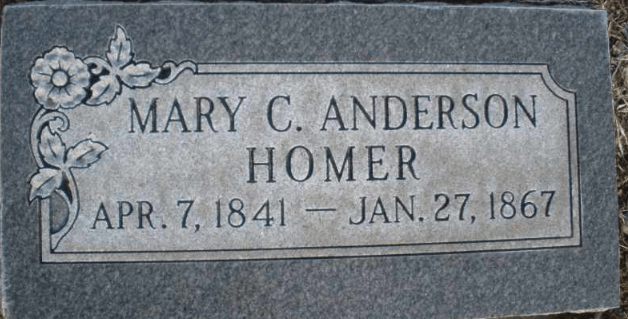
Mary Caroline Anderson Homer
R. M. H. CROCKETT
The subject of this sketch was born in Copenhagen, Denmark, April 7, 1841, the daughter of Peter and Marie Anderson. Her father died when she was quite young; soon thereafter her mother was converted to the Mormon Church. She immediately began to work and save money to bring her to Utah.
Mary suffered an accident when she was a child, causing an injury to her back which resulted in her having somewhat delicate health the remainder of her life. She was a small woman with blue eyes and blond hair. She was studious and religious by nature, enjoying reading, studying the scriptures and working in the Church. She was also musically inclined, taking particular delight in singing church hymns and lullabies. She learned to be a very fine seamstress. Her work was doing fancy stitches, embroidery and hemming on cambric. At that time frills were very much in vogue for men’s shirt fronts and ladies’ collars. At this type of work she became very adept.
Through long weary hours she sat in bed, often hungry and cold, but always kept busy stitching as she was determined to get enough money by herself to bring her to Utah with the rest of her family and friends who were planning to come. She said that she never doubted that she would be able to do as she had been promised before she left Denmark that she would come to Salt Lake and receive her endowments. During this time she studied the English language very diligently. She was able to read and write it and to speak it almost without the trace of an accent.
Finally when they had sufficient means they came to America. They stopped in Iowa long enough to earn sufficient money to continue their journey to Utah. The journey from the Old Country had not improved Mary’s health but she nevertheless persisted in working. Even when she had to spend most of her time in bed while the rest of the family were out to work, she kept endlessly on determined that she would have her own way.
In the summer of the year 1859 when a wagon train of Scandinavian people left Iowa to come to Utah, Mary Anderson and her friends went with them. This is the company of which Russell K. Homer was captain. The wagons were drawn by ox teams and were loaded with goods, chattels and provisions belonging to the company. Most of the people had to walk, however, Mary Anderson was one of the women who rode in the wagon of the captain of the company. It was a spring wagon drawn by horses, which was a very modern conveyance for that time. The details of this trip across the Plains are elsewhere given in this story and need not be repeated here.
Having no other arrangement for a place to live upon her arrival in Salt Lake City, she made her home with the Homer family and began to work at her needle craft in spite of her continued ill health. She embroidered buckskin gloves for the Walker Brothers Store and also worked as a seamstress for anyone desiring her services. In November of the following year, 1860, she was married to Russel K. Homer. There were born to them three daughters, Emily Jane, Delania and Esther.
The hardships of her own life had been such that they had molded in her a kindly, lovable character. One incident illustrates these characteristics: On the evening before her oldest child was born a young man knocked at their door and asked her for something to eat. It was long after supper time and, besides feeling very ill, she had no bread in the house. She made a fire and cooked him some hotcakes. He seemed to enjoy them very much and told her that he had just arrived from a trip across the Plains and had walked the entire distance; he was out of money and had no friends. about his plight and he was given She told Father Homer some chores to do until he could rest up and find a job. His in later years name was Harry Brown; he was a stonecutter. himself in Logan and often he went into business for ted with the Homer family in Clarkston. He was one of the stonecutter q who helped to erect the old rock meetlng house in that town.
The writer remembered when Father Homer gave Harry Brown an order for two identical headstones, one for each of his wives who were then dead, Mary Anderson and Eliza Thornton. When the stones were delivered, Mary’s had some extra fancy trimming worked on it that made it a little nicer than Eliza’s. When father asked him about it he replied that it was just to repay part for the pancakes she gave him the night of his arrival in Utah. He explained that they were the first real food he had tasted for several days and nothing had ever tasted so good to him before or since. Not long ago the writer met a grandson of this same Harry Brown, who stated that he had heard this pancake story many times, as It was a tradition in their family.
Her brother, Christian Anderson, who also came to Utah, lived for many years at Fillmore where he was the Bishop of that ward; served as editor of the County newspaper and held several city and county offices.
Mary Anderson Homer died a comparatively young woman at the age of 26 on January 27, 1867, leaving her three small daughters. She is buried in the City Cemetery of Salt Lake City, where her headstone still may be seen in fairly good condition.
Her children were as follows:
| Emily Jane Homer | Richard Hamilton Jardine |
| Delania Homer | William. Wyley Cooper |
| Esther Anderson Homer | William H. Stokes |

