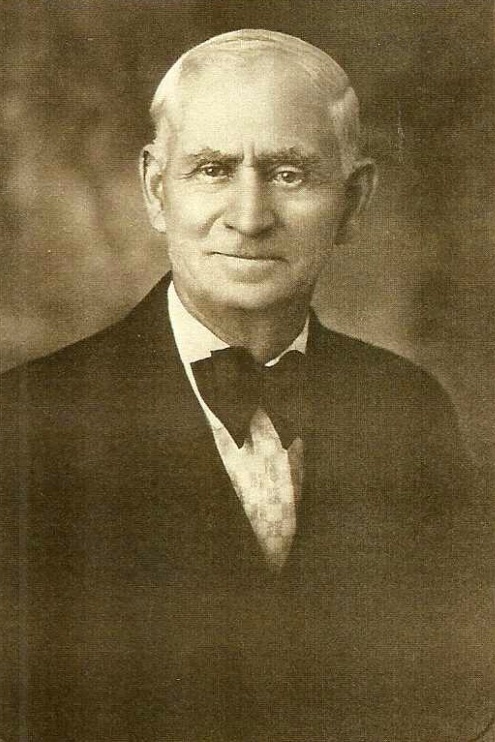
Russell King Homer, Jr.
BY LYDA HOMER LONGHURST
Russell King Homer, the youngest child of Russell K. Horner and Williamson was born at Salt Lake City, July 6, 1859. As a child, he attended an old-fashioned pioneer-type school in Salt Lake City, the seats being made of slabs with pegs set in for legs. The classes were not graded, and the attendance was Irregular. Dan Brown, Franklin S. Richards, and his brother, William H. Homer, were some of his first teachers. His favorite pastime, at which he became a champion, was playing marbles. when his family Three-Mile Creek in Boxelder County, to schooling there.
As all farm boys do, he began at an early age to share the responsibility of herding the cows, horses, and oxen, and doing the family chores. His father, in addition to his farming interests, had always been interested in raising fine livestock. He was on business on a larger scale than he had previously done in the lookout for a place where he could expand and operate this Pennsylvania. He finally decided to move his family to Clarkston, Cache County, Utah, and make his home there where the opportunity for new land and an abundance of hay and pasture were good. His father was quite prosperous in his undertakings. As the district became more thickly settled and large crops of dry farm grain were being successfully raised year after year, his land became more valuable.
At the age of 18, King (as he was always known) became more active in Church work, and was chosen one of the counsellors to the president of the Mutual Improvement Association of the Clarkston Ward, which proved to be the beginning of a long life of religious activities. He was lively and full of fun, making friends quickly and becoming a real favorite among the young people of Clarkston. The Church sponsored and encouraged social activities among the young people. Weekly meetings were held, at which all young people over 14 years of age took speaking, riding, and enjoying all forms of amusements of high standards. This of course also included dancing, sleigh riding, skating, and entertaining in their own homes, where they thoroughly enjoyed each other’s companionship and friendship.
Eleanore Maria Atkinson, a charming young lady of King’s own age, was one of his associates. She was very attractive, having dark hair and brown eyes, and was of medium height, weighing 120 pounds. King was very much attracted to her. Her father had died when she was young, leaving her mother and several small children to make their own living. Eleanore had assumed the responsibility of helping support her family. She worked first at general housework and then as a cook, and was so capable that she was able practically to choose her own employer wherever she wanted to work. In the summer of 1880, she and her brother cooked for a railroad crew who were extending the road into Montana. When she returned to Clarkston in the late fall, there was King Homer anxiously waiting to greet her with a well-organized plan all worked out ready for her consideration. He was also a very handsome young person, then 21 years of age, 5 feet, 10 inches tall, weighing 160 pounds. He had large blue eyes and dark brown hair.
After carefully considering the matter, they became engaged and were married in the
Endowment House in Salt Lake City, January 20, 1881. They returned to Clarkston to attend the shivaree given them by their friends. King arranged a dancing party for them, and they all enjoyed themselves to the fullest extent.
He first worked his father’s farm, for which he received a percentage of the crops and livestock.
During their first six years of married life, four sons were born to them—Russell King Ill, Alfred Raymond, George Albert, and Brigham Ezra. By a very unusual quirk of fortune, they acquired a fifth boy. As a neighbor, Henry Yates, passed the Homer farm one morning, he stopped for a friendly chat to see if he could bargain for some fat pigs that were in the barnyard. After joking back and forth a bit, Mr. Yates said, “I have a boy whom I will trade you for two of those pigs.” King knew the Yates family had no children, so he accepted the offer of trade, thinking it to be quite a joke. The next morning, Mr. Yates brought the boy, whose name was William Lester, with all his clothes and belongings, to the Homer farm, saying he would call and get the pigs later. Henry Yates had recently returned from a mission to England; a family of converts there had wanted him to bring one of their boys to America to find a home for him where he would have good care until his parents could come at a later date. King accepted him, and he received him into the Homer home and treated him as a member of the family.
King and Eleanore were much concerned about getting a home of their own. Land values had so increased in that locality that they decided to seek opportunities elsewhere. They received many favorable reports from the Utah people who were going to settle in the Snake River Valley, so they determined to go there to make their home. Accordingly, they had their horses shod, their wagons repaired, the furniture and personal belongings and their family of five all loaded for the trip. Russell K., Jr., was seven years old. He and Willie Lester were on the ponies ready to drive the loose horses and cattle. Thus they were ready to start on their 250-mile trip into their new adventure.
Their baby boy, Brigham, was ailing when they left Clarkston. Instead of getting over it quickly as they had hoped, he continually grew worse until they reached Ross’s Fork, now Fort Hall Indian Reservation, which was about half way on their journey; here he became so sick that they were afraid they would lose him. As the sad hearted parents sat by candlelight in their covered wagon, anxiously watching their almost dying son, the noise of an Indian powwow and the howl of coyotes added still more to their nervousness and anxiety. They exercised their utmost faith and prayers in behalf of their baby and felt that by this means his life was spared, as he began to improve in health from that night on.
The next morning, they made their way slowly and with difficulty through the heavy desert sand on to Blackfoot, only to receive orders from the Sheriff of Bannock County that they must stop and brand all their cattle. A quiet day of rest for the sick child, his mother, and their tired horses, while the cattle were being branded, seemed to lift the dark clouds and prepare them for the last 80 miles of their journey. A few days later, they were joyously welcomed into the home of King’s sister, Esther Homer Stokes, who then lived at Lewisville, Idaho. Rest, good care, faith and prayers soon brought improved health to their baby.
Early the next Monday morning, King set out with high hopes to look for land on the great flat plains of the Snake River Valley. He soon learned that the choice land located under the irrigation system had already been homesteaded, and chat land there without irrigation was useless. Day after day, he travelled the country over without results. Finally, he extended his search into the Rigby section where he met a man named Summers who offered to sell him his rights in his homestead. After several days of study, they both went to Blackfoot, where the transfer was made at the Government Land Office. King and his family then moved into their new home about two and a half miles’ northeast of the Rigby township. The improvements on the place consisted of a one-room log house with a low dirt roof, and a small log barn. About five acres of land were cleared and fenced; the rest of the 160-acre farm was covered with sagebrush. There was a challenge for the most rugged and determined pioneering spirit. There were crops to be planted, living quarters to be provided, fences to be built, the land cleared, plowed, seeded, and irrigated. The first harvest consisted of a few bushels of wheat and a load or two of alfalfa hay. There was an early winter, and before January l, hay was selling at $20 a ton, with the Howe Brothers being the only ranchers who had any for sale. Hay for horses and cattle was out of the question, so they had to subsist on straw and chaff. Although the cows quit giving milk and the horses were in a terrible condition, they managed to pull through the winter.
By early April, the frost was out of the ground and the spring plowing had to be done. King put two of his teams in the little log barn, filled the manger with straw and chaff and sprinkled alfalfa hay over it. They seemed to start eating the hay, and continued to eat right on down till the manger was empty. This gave the horses sufficient strength to do the farm work. There were two hand plows, one for King, and the other for his two oldest boys. He would lead the way with his plow, and the two boys would follow behind. Russell would hold the plow, and Ray would walk alongside and drive the team. They would go around the land once, then while the horses rested, they would pile and burn sagebrush on the adjoining land. Ten hours was a day’s work for the boys, but King would work from four a.m. till eight p.m., many times eating his noon-day meal in the field to save time. After the crops were planted, came the task of making ditches to irrigate the crop. The land was so uneven that it required the work of a genius to put ditches in the right places. When the water was turned into the newly-made ditches, it would pour through the loose dirt banks like a sieve and flood the low places and drown the crop, while on the higher places, the crops were scorched with the hot sun. King was an experienced dry farmer, but inexperienced at irrigation, so he worked night and day to nurture and mature his crops. Yet, when fall came, he had very little to pay him for a year of hard work.
In the little log house to which another room had been added, his faithful companion, Eleanore, was doing her part. When she had a good supply of milk it was easy to prepare the meals for the family as they all enjoyed bread and milk, but during the winter and spring, they had no milk, no butter, no meat. Tom Saxton, who was the nearest neighbor and had enough hay to keep milk stock during the winter, would sell Eleanore a quart of milk about every other day. To this she would add a quart of water, then divide it between the six in the family. Later in the spring, she would send one of the boys three miles to buy ten cents’ worth of rhubarb from Pete Blacksmith. When King and the boys were too busy to haul driftwood from the dry bed, she would burn sagebrush. During the coldest months of winter, water could not be obtained from the nearby canal, so it was necessary to haul it from the neighboring farm house of C. J. Call for house use.
They lived the real pioneering life. The nearest store was at Lewisville, seven miles away, and the nearest railroad town, Idaho Falls, was 20 miles distant. Still they managed to enjoy life.
Each Sunday, all would come together in the log schoolhouse to hold Sunday School and Meeting. Each Friday night during the fall and winter months, the benches would be moved back to the walls, and they would have a lively social and dance. Oscar Myler with his fiddle and Jody Coucher with his banjo would furnish the music for all to dance until about eleven P. M. when a picnic would be served while the musicians had their rest.
The Rigby Ward was organized May 22, 1886 with George A. Cordon as Bishop and Dan Robbins and Josiah Call as counsellors. In 1889, Dan Robbins was released as counsellor and King was called to act in his place. He was ordained High Priest and set apart in the Rigby Ward bishopric. In addition to their ecclesiastical duties, these men were all good friends and associates in many enterprises, including the organization of irrigation companies, building roads and canals and other projects for the good of the community at large. When one of their fellow members or friends was ill or met with reverses beyond his control, all would give a few days’ work to plant, care for, or harvest his crops for him.
During the next ten or twelve years in Idaho, great changes were wrought. Fields of alfalfa, wheat, potatoes, gardens, and fruit orchards took the place of sagebrush. King Homer erected himself a nice new frame home.
King’s father passed away at Clarkston February 12, 1890, after which his mother, then 74 years of age, came to make her home with him, her baby boy. King built her a very comfortable two-room house about a hundred yards’ distance from his home, where she could have the privacy and quiet she desired. All of her grandchildren dearly loved her, and each night one of them would stay with her. Two years later, grandma’s brother, John Williamson, was left without a home so arrangements were made for him to come and make him home with her. These two elderly folks lived happily together until his death in 1903. After that time, she gave up her own home and visited about with one and another of her children until her death, June 11, 1912.
Five children were born to King and Eleanore in Idaho. They were as follows: Elnorah Ann, William Harrison, Edmund Earl, John Mayhew, and Eliza Loreen (Lyda). King and Eleanore had missed their friends and relatives, but had by no means forgotten them. They thought how nice it would be to get the family together once more while his mother was still living. Plans were started to hold the first reunion of the Homer family during the summer of 1900. Everyone who was related on the Homer side of the family was expected to attend. A day or two before the time set, the covered wagons and buggies began to arrive from Cache Valley, Bear Lake, St. Anthony, Rexburg, and many other places. More than 100 persons met at this reunion. A program was held on which some member of each family took part. This was a time of rejoicing and happiness for all of the relatives who had been separated so long. King was elected the first president of the Homer organization. The organization has been carried on for more than 40 years and is still in existence and active.
About twelve or fifteen miles east of Rigby where the snake River comes winding its way from the mountains lay a tract of land called “The Foothills” by the nearby settlers. Thousands of acres of this land, covered with grass and dotted with quaking-asp and pine groves, had served as a pasture or dry range for cattle. King had been casting a wishful eye at this land for years, as it resembled the rolling hills of Clarkston which he used to farm for his father. Time and again, he expressed his opinion that crops of grain would mature on that land; other experienced dry farmers agreed with him. He and his boys began to experiment by planting a few acres of wheat and rye. John Wheeler, a brother-in-law and a dry farmer from Clarkston, joined him in the venture. They planted 40 or 50 acres into fall wheat, and it matured satisfactorily. This, so far as we know was the first dry farm crop raised in the Snake River
Valley. A very few years thereafter, millions of bushels of grain were grown there in that way.
King acquired 640 acres of this foothill land which he, his mother, and other members of his family homesteaded. It was partly divided by Birch Creek, which gave him plenty of water for domestic use. Instead of hauling the crops to market, he raised pigs and drove them to market the same as cattle or sheep. This became quite a profitable venture.
Mr. Samuel Hammer owned 160 acres of irrigated land, with all the water rights to Birch Creek, just across the road from King’s dry farm. King sold his Rigby property, and purchased this 160 acres of rich, level mountain soil, all under cultivation and irrigation. This gave him the necessary improvements, alfalfa and timothy hay, fruit, water, horses, machinery, and equipment for a very fine farming set-up. With the help of his seven sons, each succeeding harvest brought him larger crops of hay, grain, pigs, cattle, and horses.
It was necessary for King to be released from the Rigby bishopric, and to move his family from their friends and the many conveniences they had acquired in Rigby. He was made Presiding Elder in the Birch Creek branch of the Church. The school board permitted them to use the schoolhouse for Sunday School and other meetings until some of the people objected. The privilege was then withdrawn, and they moved their meeting place to King’s residence, where they continued their activities until the members provided themselves with a new church made from white sandstone quarried off the Homer farm.
During the period from 1902 to 1920, many changes came into his family life. One by one his children married and left home. In 1908, his son, A. R. Homer, was called to a mission in Germany and Switzerland, where he served for thirty months. John M. finished his high school education in 1918, and immediately went to Camp Lewis, Washington for training in the United States Army.
As King and Eleanore entered their 60th year, they found themselves with only their baby girl, Lyda, at home. Hired men were almost out of the question during the war, and it was impossible for one man to do the work on his large farm. They sold their place to their neighbor, Peter McFarland, and moved to a small 25-acre farm in Idaho Falls, where they could run a few dairy cows and chickens.
As early as 1910, Eleanore’s health had begun to fail. She had three major operations, and was in delicate health during the remainder of her life. In February, 1925, she took a cold which developed into pneumonia, and she died on Washington’s birthday of that year. She was buried in Rose Hill cemetery in Idaho Falls, King deeply mourned the loss of his companion. He sold his home, with the intention of spending his time in travel and in visiting with his children, relatives, and friends. This did not provide him with the contentment he thought it would, times when he thought he would like to reestablish his home. He renewed his acquaintance with an old friend, Lavina Myler, and they were married. In less than Year, she Passed away, leaving him alone again. Still is contented and unhappy, he travelled from one place to another visiting with his children. The winter of 1928, he spent in California where he met and married Margaret Burbidge. This marriage did not prove compatible and they were divorced. His sister, Mary Ann Homer Boram, was then alone and ill, so he returned to Rigby to live with and take care of her. He nursed and cared for her for many weeks; there was no improvement in her health, and she was finally removed to a hospital where she passed away. Another sister, Lovisa H. Thornton, who was then 82 years of age, was living at Blackfoot. She was also ailing, so he went to stay with her for some time.
For the next few years, he devoted considerable time to Temple work in Salt Lake City and Logan. In May of 1935, he went with a group from the Salt Lake Temple on a trip through the Northwest, in the course of which they visited the Mormon Temple at Cardston, Canada. In September of that year, he went to New York to visit with his son, A. R. Homer, and his family.
He was always a good correspondent and wrote frequently to all of his children and to many relatives and friends. As he grew older, his hand became unsteady so he used a typewriter for his writing. The following is taken from a letter he wrote while in New York City which shows his reaction and interest in the new conditions he met while on his eastern trip.
I go for a walk every day, but I don’t get off our own street. I am completely turned around here; east is west and north is south. If they had the streets numbered and the cars and buses numbered like they do out west, then I think I could find mv way. We can catch a bus right at the door and ride a few blocks and then change and go on the subway car and go on it, but it is underground part way and up on the third story part way so a person that don’t know when and where to get off and on could not make much headway going anywhere.
“September 27, 1935, Long Island, New York. I have been doing some scouting around since I wrote to you last. Ray had some business in Philadelphia; we all went with him. New York is surrounded with water; there are three ways out. One is on a bridge over the Hudson river a mile long, another is a tunnel under it three miles long, the other is on a ferry boat across the bay five miles across. We went through the tunnel into New Jersey travelling across the State of New Jersey and part of Pennsylvania. It was the most beautiful country I ever saw, such beautiful parks and shady highways and nice big estates with such magnificent homes, real palaces some of them, big fields of corn, wheat, and dairy cows as far as the eye could see. When we got to Philadelphia, Delva took me to the Independence Hall where the Declaration of Independence was signed. We saw the chairs and table and the silver inkstand that was used on that occasion; many other relics too numerous to mention. Then we went to the house where the first flag was made by Betsey Ross, saw many quaint old things that were very interesting to me. We then went to the old church where George Washington attended church. I sat in the same pew that he did, his name is still there on brass plate. Betsey Ross’s pew is next to his; I sat there too. They are common square box seats. On our way home, Ray took us to Valley Forge where Washington lived, and the barn where he kept his horse is still intact, and the buildings and furniture seem to be in a very good state of preservation. On our way home, we passed the point in the Delaware River where Washington and his army crossed the river in the small rowboats when the cakes of ice were larger than the boats.
He left New York City December 28 to return home, travelling by the southern route. He stopped in Washington, D. C. for a short time. From there he went to Los Angeles, California and spent the rest of the winter with his children, going on to Idaho for the summer. Early that fall, he returned to Salt Lake to resume his duties in the Temple, at which he worked very hard and diligently, often walking two miles or more to his work. His records show that he performed 752 endowment ordinances, and also took part in the sealing’s of several thousand couples and children to their parents. In one day, he acted as witness to 1500 baptisms for the dead. During the time he was working in the Temple, he met Christina Rasmussen, a coworker in the Temple. They were married in October, 1936. The following year his health began to fail him and he had to discontinue his Temple work. He was under a doctor’s care for more than a year. They discovered a growth in his abdomen, but did not recommend operating on it at his age, which met with wishes of his family.
In May of 1938, he and his wife returned to Idaho Falls to make their home near his son John and family. On December 31 of that year, his wife died, leaving him alone again, and two months later, he became bedfast as a result of an anemic condition, but he responded to treatment and was able to be up and around again.
The last year of his life he spent with his three children— John M., Lyda, and Nora—each one taking care of him when he couldn’t care for himself. He was finally taken to the L. D. S. Hospital for transfusions, but they didn’t seem to help. Everything possible was done to restore his health, but his condition continued to grow worse until he passed 1940 at the home of his son, John away February 21, Homer. He was laid to rest in the Rose Hill cemetery at Idaho Falls beside his wife and companion, Eleanore. He left a family of nine children, thirty-seven grandchildren, and eight great-grandchildren.
His children were as follows:
Russell King Homer, Jr. Ella Minerva Flitton
Alfred Raymond Homer Delva Haycock
George Albert Homer Edna L. Stauffer
Brigham Ezra Homer Elizabeth Blakely
Eleanor Ann Homer John Orr Grover
William Harrison Homer Rose Edna Finn
Edmund Earl Homer Elda Day Muir
John Mayhew Homer Leona Eliza Theurer
Eliza Loreen (Lyda) Homer Willard Leslie Longhurst

