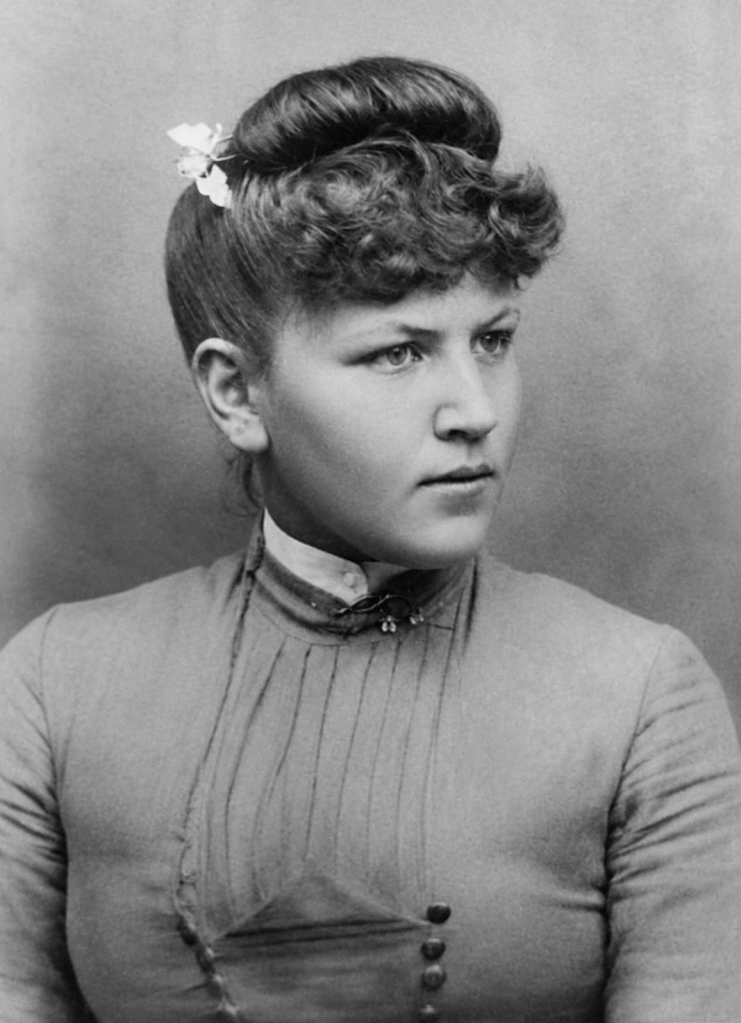
Rachel Maretta Homer Crockett
On April 15 of this year (1940), I arrived at the age of seventy years, and my family, out of respect for me and to express appreciation that the Lord had permitted me to live to the allotted time of man, three score and ten, celebrated with a banquet. My three sisters, Delania Homer Cooper, Sarah Homer Clark, and Rebecca Homer Costley, each came a long way to celebrate with me. We did appreciate their coming as they are all well past seventy. The celebration and dinner were a complete success; the food, both as to cooking and service, was perfect. The thanks that Allan gave at the table was worth living seventy years to hear.
Not long afterward, while I was visiting with my daughter, Ida, in California, I took sick. As I lay there, the thought came to me that I could do something to express appreciation of the whole affair by writing something of my life for my children and grandchildren and others who might want to know something about it.
In my 20’s, I looked upon a person of 70 as old, and, in fact, aged. At 40, I had not begun to feel old, and at 50, I did not feel any older. Now that by calculation, in terms of years, I know that I must be old, I still do not feel so, and I am not shocked. I have just passed another milestone in a pleasant journey. The whole of my life has been filled with varied and interesting experiences.
As is related in my mother’s history in this volume, I was born at Three-Mile creek under real pioneer conditions. 1 have no recollection of the home at Three-Mile creek until we returned there to live with mother Homer after the death of my mother at Swan Lake. I remember the evening of our arrival. We had been travelling for days in mud and rain. Everything was so damp and cold we were chilled to the bone. Mother Homer had a bright, warm fire shining in her hearth and she was cooking supper. In fancy I can see her now as she moved about dishing up the good warm food. I sat on my father’s knee in a cozy corner by the fire. I was just three at the time, and young as I was, my heart surely warmed toward her. I pulled father’s ear down to my lips and whispered, cc What is her name?” In a broken tender voice, he whispered back, “Her name is mother.” Those magic words were music to my ears, especially as it proved as he said. She was indeed a real mother to us children, who badly needed a mother’s care at that time. She took my own mother’s children to her as though we were her own and made a home for them until they were grown men and women.
Most of my childhood recollections center around the dear old home in Clarkston where the many happy hours of carefree childhood were spent. What loving memories cling around every nook and cranny! – How we knew and loved all the dear old friends and neighbors in that little village! Everyone was everybody else’s friend. So many bright and happy memories come to mind as I write that if there were any happenings not so pleasant, they are so completely overshadowed by the more happy ones, that they have no place in this narrative.
I started to school in the old log schoolhouse at Clarkston. Some of the finest friendships and fondest memories of my life emanate from that school. Most of them are now only fond memories that I must think of with a note of sorrow, as they are gone that bourne from whence no traveler
My first day at school I met my lifelong friend, Minnie returns. Malmberg. There was nothing unusual about our meeting. She was a little, fair-haired, blue-eyed girl playing in the snow. She seemed so joyous and full of fun that I was attracted to her. Our beautiful friendship which began that day lasted 65 years. She had a keen sense of humor and was always the life of the party. These attributes stayed with her throughout her life. Soon after we became pals, my brother Josh dubbed us the twin sisters” which stayed with us. The people of the town called us “the twins.” We were always together, and no one ever thought of inviting one of us without the other. A more loyal, loving, and understanding friend never lived.
Our school was a very primitive affair. All of the-town children of school age were taught in one room, so we were ungraded. We had uncomfortable, home-made wooden bench. We paid tuition and furnished our own supplies, or did without them. Each student studied about as he or she pleased, and did not bother with the things they didn’t happen to like. I was greatly interested in and therefore excelled in geography, reading, and spelling, while writing and arithmetic were very much neglected. On each Friday afternoon, we played geography games and had spelling bees. My chief competitors were Dolly Clark and Annie Larsen. During our school lives, we never really knew which one of us would carry off the honors, but I won my share of these contests.
My parents never permitted me for any reason to stay out of school or be late. I made a record of seven years’ attendance without being tardy or absent. After I completed the grammar school in Clarkston, I was 14 years of age. I should have gone away to school but father would not hear of a girl going away alone to a strange town to school.
Up to that time, my responsibilities at home had been few because the older sisters had done most of the housework, rather than bother with me, so I played through the long, sunny hours of summer, or over the crusted snow bank and ice fields in the winter, doing about as I pleased, with two reservations—I must be home at mealtime and be-
The older girls got married and left home, and I had more cares to attend to. Mother Homer was getting to an age when the mind travels backward. I always had an unusual amount of interest in family history and genealogy. She enjoyed talking of her early life and experiences, so I really got well acquainted with her and their early life in the eastern United States. She also told me many stories, legends, and superstitions growing out of the folk lore of her time.
Clarkston, situated in a cove under the mountains as it is, was quite secluded from other towns, so it developed its own social life. In the winter time, we had a public dance once a week. We also had a private party at nearly every house in the town once each winter. Occasionally we had a school or church exhibition or drama put on by the home talent. I sang in the church choir and took part in nearly everything by way of entertainment.
The summer I was 18, I went to Malad, Idaho to work for a Mrs. Henderson who ran a dairy. She had quite a dairy business; besides her own family, she hired 12 girls and several boys to help with the work. I remember particularly that soon after I arrived, I overheard her say to her husband, “ That girl will be the leader of this bunch, but I can trust her and won’t have to worry about her.”
I wasn’t adapted to the dairy business. My hands would not stand the milking, so I got a job at the Peck Hotel in Malad, where I worked for three months before returning home in the fall. I enjoyed that summer in Malad perfectly. I was the right age and disposition to get on well with the young people of both sexes. Two of my girlfriends from Clarkston were there and we really had a great time. When we went home in September, we felt very important and worldly wise because we had been places and seen things the rest of our crowd had not. For the next two years, I remained at home working for my married sisters when they had babies or extra work, still having a wonderful time and enjoying the social life of our town.
At that time, it was customary for all young people past district school age to get married. Old maids were very unpopular; “bachelor girls” and “career women” were unheard of. Any young man who did not soon seem inclined to assume the responsibilities of marrying and maintaining a home was very much criticized; so it happened that my best boyfriend and I decided we had better keep up with our social set and get married. I had met William (Billy) Jones of Brigham City in the spring of 1886 at my home in Clarkston. One evening when we were entertaining a few friends, a mutual friend, Willard Archibald, had brought him to our house and introduced him; coming from Brigham City, he was a regular foreigner so far as the town was concerned. He was a handsome young man with a good singing voice, and made quite an impression upon us. He had a flock of sheep up in the hills near Clarkston, and spent the summer around there herding them. We just saw each other occasionally from then on until the fall of 1891. We were married December 25, 1891, by Justice of the Peace, Charles Montrose, at Weston, Idaho. My cousin, Lovisa Thornton, and a friend, Ira Bryant, went with us. When we got back to Rinda’s that evening, we found that she and my brother and sisters who lived in Clarkston—- Josh, Sarah, Rebecca, Ginnie, and Lula—had prepared a banquet and invited quite a company of friends for a wed-
we went to live on a farm in Malad valley at St. Johns where we lived for four and one-half years, living like a couple of carefree children who had no responsibilities and did not care to assume any. My oldest son, William Homer Jones, was born in Malad, March 6, 1893. on April 14, 1896, as Mr. Jones was unhitching the horses from a sulky plow, a sudden thunder shower came up which frightened the horses into running away, dragging the plow over him. He was badly injured internally. He lingered two weeks and died. I then stayed with my very dear friend, Wealtha Drake, in Malad for two months, after which I went to stay at my sister Sarah’s home in Clarkston where my second son, Willis Noble Jones, was born August 26, 1896.
I was very unsettled in my mind, and undecided what to do in order to raise my two fine boys. Many of our family had gone to the Snake River country. I went there to spend the winter, and visited around with mother, Mary, and King at Rigby, Josh and Visa at Parker, Rebecca at St. Anthony, and Lula at Plano. The next summer I returned to Clarkston to find that my brother Dave’s health was getting no better. He was taking treatment from Dr. Ormsby, who wished him to be in Logan. We made plans to make a home for Dave, myself, and my children in Logan, where I was to take training and practice obstetrics with Dr. Parkinson. Dave was suddenly taken worse, and died October 26, which necessitated my changing my plans again; so I returned to Parker, Idaho and located there. In December, 1898, I went over to Rigby to spend the holidays with sister Mary. She ran a small country store just outside of Rigby. On Christmas day, R ve Harris, my pal and I were at Mary’s when some neighbors came along on the way to a dance. Mary volunteered to tend our children, so we went along. Shortly after we left, a young man, John Allan Crockett by name, came in the store with his girl on the way to the dance. Mary told them about Rye and me being at the dance. She asked John to dance with me as she was afraid that I, being a stranger, would be a wallflower. Soon after the dance started, as I stood near him on the floor, I heard him ask Rye to introduce him to me, to which Rye replied, “Why there she stands right by you, and didn’t he look surprised and sheepish as he realized I had heard him ask about me. After the introduction he said to me, “Why I expected to see a middleaged woman sitting in the corner, instead of meeting the belle of the ball.”
After that remark, we really got along very well. Through the rest of the holidays and during the month of January, we went to several house parties and dances together. About the last of January, I went home to Parker. He soon followed me over there. We were married February 9, 1899 at the St. Anthony courthouse by Edmund Z. Carbine, the bishop of Parker and county clerk, who was an old friend of both of us. We decided to live in Parker, so John sold his land at Lewisville, brought his horses, cows, and farm implements to Parker. John’s brother, Don
Crockett, a boy 13 years old came to live with us there. We rented 160 acres of land from John Moon. We built our own house and outbuildings and did very well there. Our two daughters, Genevieve and Ida, were born at Parker.
Our friend, Axel Anderson, went to Payette valley. He brought back reports of a much milder climate and fertile soil, which sounded very alluring. I was very much in favor of going there, but
John liked Parker so well that he was reluctant to leave. We finally decided not to sell out in Parker, but to go to Payette for one year. We stayed there 14 months, but John did not feel satisfied there. He wanted to go back to Parker. We ended up by compromising and going back to Cache Valley. We went to John’s home town of Smithfield. The sugar beet industry was at its height and land had gone up so that there was little chance of getting established there. While we were living in Smithfield, our son, John Allan, was born in January of 1906.
John had never been anything but a farmer, and could not get interested in anything else. His brother, Walter Crockett, had already gone to Alberta, Canada. He seemed to like it quite well, so John went up there and made arrangements for us to go. In May of that year, he chartered a car for our livestock and chattels and travelled with them to Cardston, Canada. The children and I went by passenger train. We were enroute to Canada while the San Francisco earthquake and fire were on.
We first went to Walter Crockett’s ranch on Boundary Creek, which is so called because it is close to the American border. We stayed there until school began in the fall when I went to live in Cardston, Alberta to send the children to school. It was a new fertile country just being developed into farming land. Most of the land had to be broken up from original prairie grass. John started to break up land as soon as we got there, and continued to break more land and plant crops each year. The climate was so cold and the season so short that wheat raising did not prove to be very successful. For my own part, I never did like Canada. The winters were so extremely cold and bleak, and the crop failures so discouraged me that I always longed to come back to Utah. In addition to this, we had our farm land quite a ways from town. I lived alone with the children most of the time in town while John suffered much cold and hardships trying to live alone and farm on the ranch. We lived there until 1914. Our three next children—Russell, Maretta, and David—were born there.
In the summer of 1912, I returned to Utah for a visit, taking with me my children, Allan and Ida and Maretta. We attended the Homer family reunion held at Lovisa Homer Thornton’s at Blackfoot in June of that year. When we decided to return to Utah in 1914, John had planted a large acreage of wheat, and though he must stay to harvest it. While the entire crop was still green, it froze so hard that the heads were full of ice and the crop was entirely lost.
We spent that winter in Clarkston where the children attended school. In the spring, John and his brother Walter began looking around for a farm to buy. They located one at Rexburg, Idaho, which they bought. On Saturday, June 10, 1916, midnight, John boarded the train at Idaho Falls to return to Clarkston. Between five and six o’clock Sunday morning, June Il, the train arrived at Trenton. At small towns it stopped only when it was flagged, or to let passengers off. Apparently, it made a very hurried affair of stopping to let him off. In some manner, his overcoat or clothing got caught, and he was thrown under the wheels of the train and killed. The check he had given on the farm property did not reach the bank until after his death, and the whole deal was cancelled. We buried him in Clarkston.
At that time, I had eight children; mv oldest son, Homer, had been serving in the United States Navy since 1912. Noble was working on the railroad in Pocatello. I and the younger children were living in Clarkston. It did not appear to me that the future offered much for them in that town, so I bought a home at 246 South First East Street in Logan, Utah. It was a comfortable home with a nice garden plot where we raised plenty of vegetables and some fruit. Genevieve and Ida worked at various jobs in the knitting milles and the Borden condensed milk factory, while the boys, Homer and Noble, were very generous and diligent in sending money home each month to help support the family; so we got on very well.
After we had lived in Logan for five years, both of the girls got married. Noble’s railroad work was then such that he could be stationed in Salt Lake. Considering that there were better opportunities for the boys there, we moved down to Salt Lake in September of 1921. we bought a house at 328 H street where we lived for fifteen years. By that time, all of my children except the youngest, David, were married, so I sold the place on H Street, and for the past several years have lived in an apartment in town.
During my lifetime, I have enjoyed very much being active in Church work, always trying to do my bit in the various organizations. It has usually fallen to my lot to be either Secretary or Class leader. In Logan I put in a lot of time working in the Temple and doing Genealogy. Since I came to Salt Lake I have also done a lot of genealogy and Temple work, together with Relief Society work. I served as class leader of Social Service in the Relief Society of the Twenty-first Ward, 7 years.
In connection with this work I took a course in Social Service through the extension division of the University of Utah, under Drs. E. E. Erickson, Calderwood and Beeley.
Since I began work in the Logan Temple years ago I have spent a lot of time taking notes and gathering material for a Homer family history. I have studied in the genealogical libraries of Los Angeles and Salt Lake. Now that my children are all married and I am left to myself a great deal, outside of the routine work of keeping my house in order, I try to keep busy with genealogy and family history.
My family:
| William Homer Jones | Bertha Crump |
| Willis Noble Jones | Alice Young |
| Genevieve Crockett | Leon F. Bastow |
| Ida Laurene Crockett | Howard L. Starr |
| John Allan Crockett | E. Eulalia Smith |
| Russell K. Crockett | Naomi C. Johnstone |
| Maretta Isabel Crockett | Harold W. Rushton |
| David Leonard Crockett | Marie Werner |

