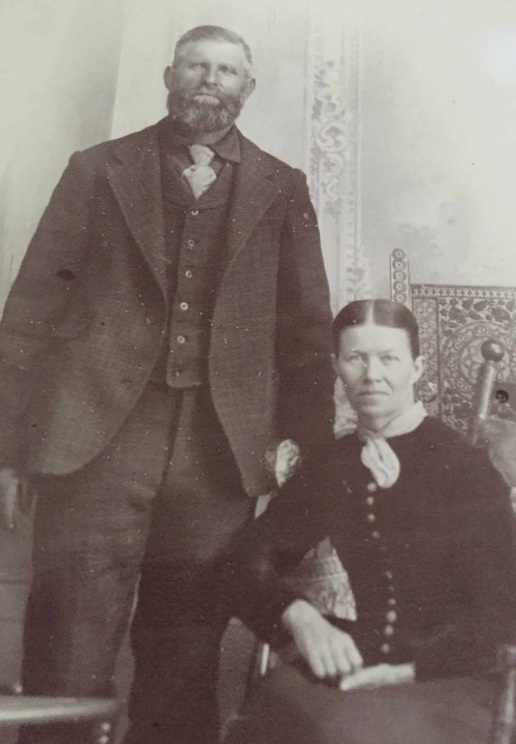
Alfred and Mary Ann Homer Borem
Mary Ann Homer Boram
BY LYDA HOMER LONGHURST
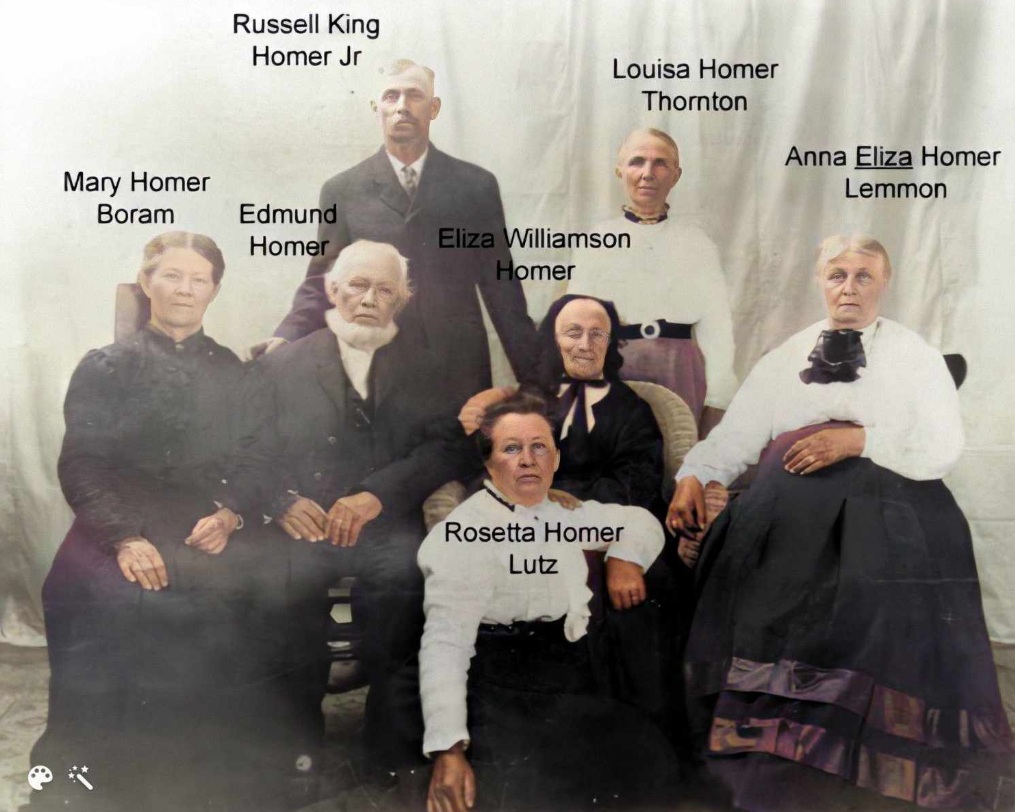
On December 13, 1854, a daughter, Mary Ann, was born to Eliza Williamson and Russell King Homer at Crescent City, Iowa. There was much rejoicing by the father and mother and brothers and sisters of the Homer family. She came into a home where all shared the responsibility of making a livelihood and taking care of things, so there was love and unity. When she was just a baby, she was afflicted with a very serious illness, which left her a cripple for life. Handicapped in this way, it seemed that she had a greater desire to do good and realized that her own happiness would depend on how well she served others. With this ideal in life, she cultivated a disposition of patience, love, and kindness for everyone. She was four years old when her parents made the trip in a wagon train across the Plains from Iowa to Salt Lake City. The details of this trip and their family life in Salt Lake City, ThreeMile Creek, and Clarkston are told in the histories of her parents included in this volume.
She began to attend grammar school in Salt Lake City She had a very bright and retentive mind, and all of her life was interested in learning. She was baptized at Salt Lake 1865. City, June 11,
Being a girl of unusual ability, she read and studied, improved her mind, and learned to do fine sewing and handwork. She was of such a pleasant and friendly disposition that she acquired many friends and admirers. She was older than her half brothers and sisters who had been brought, after the death of their own mother, into her mother’s family. She was very affectionate and motherly to them. Her sister Maretta writes of her:
“When I first went to mother Homer’s at Three-Mile Creek after my own mother’s death, I was three years old. I had the whooping cough and a felon on mv finger. How tenderly and faithfully Mary cared for me! She took me in her bed so she could care for me through the night; she washed me and curled my hair, and showed me off to callers and she repeated the cute things that I had said and done like the fondest mother might have done. Her kindness was not confined to me alone. In the same way, she had mothered Esther after her mother’s death. Later she likewise took charge of our brother Dave Homer and cared for him.
“She made our clothes by hand, and did much of the knitting, mending, and darning. In a family where there are so many children, mother Homer could not possibly have managed to get along had it not been for the help of Mary. In addition to our own family, there were always travelers and hired help to be cooked for and waited upon. Mary was a regular second mother to us. She kissed our bumps, tied up our wounds, smoothed out Injured feelings, and with patience and understanding straightened out the difficulties that sometimes arose among us.
“When we lived at Three-Mile Creek, there were gold seekers going to California, passing our place most any hour of the day and night. Most of would call at our house for something, if only a drink of water. They were a motley procession, travelling with every mode of travel—wagon, coach, horseback, mule back, leading a burro with a pack or tramping along on foot with the rag, tag, and bob tail lagging along behind. There were Indians in the vicinity. We children were often frightened of things both and imaginary. Mary would always put on a bold front and stave off our fears until the folks returned. We were two families of children and some of them old enough to miss their mothers. When one would start crying, they would all cry together. One day they all sat out on a hayrack crying. I came to the house singing, and Mary asked me, “Ret, what are those kids crying for?” And I replied nonchalantly, ‘Oh, they are just howling because their mother is dead.’ This struck her so funny that she had many a good laugh about it thereafter. She went out and soon had them interested in playing a game and all their troubles forgotten. In winter she used to tell the most wonderful bedtime stories to us. Our favorite story she patiently repeated over and over to us every night. She would give comic readings, make stump speeches, or most anything to entertain and make people laugh.
“Being unable to walk much, everyone was interested in seeing that she got about. She enjoyed riding on horseback, and any of the neighbor boys going on errands would ride up to the door and pick her up behind them to take her for a ride. Father remarked that he could always depend or Mary being at the door with her hat on whenever he was ready to drive somewhere.
“Her interest in us did not relax as we grew older. She was mother, teacher, and sister to all of us all her life.”
When the family moved to Clarkston in Cache County, she was a young lady and was honored by being made the first “Goddess of Liberty” there at a Fourth of July celebration. She was among the first students to attend the Brigham Young College after it was established at Logan. She was interested and active in Church work, serving as first president of the Young Women’s Mutual Improvement Association in Clarkston.
She began teaching school in Clarkston in 1876. she was so fond of and interested in children that to her teaching was when school was out that year, she went to Salt Lake to visit friends and see the doctors who had been treating her in the hope that she would be able to walk without crutches. On that occasion she attended a Relief Society meeting at which she was very much impressed by the fact that an elderly lady by the name of Whitney sang a song in the pure language of Adam which was interpreted by Mrs. Zina D. Young. As she was a very good penman, Patriarch John Smith asked her to write the blessings as he gave them. On November 23, 1876, she copied the first blessing.
The following was taken from her diary: December 13, 1876. “My birthday, just 22 years old, still it does not seem long since I was a little child, and if all the years pass as quickly and happily as most of those have, I shall consider myself most fortunate indeed.” March 24, 1877. “A young ladies’ retrenchment association was organized; I was chosen the first president.” November 2, 1877. “Went to meeting, also a Danish meeting, never got so tired of meeting, and surely got more than paid for my curiosity.” January 27, 1879. “All the folks have gone to the dance but me, and I never had the blues worse in my life.
She was awarded a certificate to teach school after having passed her examinations at the Brigham Young College at Logan. For the next ten years, most of her time was spent in teaching school. As a school teacher, she was very successful. She organized spelling bees, geography games, and contests of all kinds to break the monotony of regular classwork.
In 1890 she went to Rigby, Idaho to teach. There she met Alfred Boram, to whom she was married on July 4 of that year by Bishop George Cardon at the home of her brother, King. She wrote in her diary concerning this: “There were about a hundred guests present, and to me it was the happiest day of my life, and my Alfred seemed very proud and happy, too.”
They resided near Rigby. she served both as secretary and as president of the Young Women’s Mutual Improvement Association. February 12, 1892, she was set apart as teacher in the Sunday School, and taught until 1896.
May 14, 1897, they moved to their own home west of Rigby, where she began her buying and selling business. At first she bought and sold things that she ordered from catalogues. She travelled around from house to house selling the articles of merchandise she purchased. Thereafter, she began to put in a stock of merchandise in her home, and let people come there to do their buying. Her home was very small, but she used one room for her store. Soon she had it well stocked with clothing and groceries. She put in a nice stock of ladies’ hats, and in her experience of buying and selling, she developed the art of making hats and trimming them, using her own combination of colors. She had the best millinery business between Rexburg and Idaho Falls. Even though her store was four miles out of town, people travelled out there whenever they wanted good hats.
With the increase of her business, she found it necessary to get help. Her niece, Elnorah Homer, a daughter of her brother, King, came to stay with and help her. Through the love and affection, she had for her aunt Mary, she endured the criticism, nagging, and scolding that she got from her uncle, Alfred Boram. Elnorah learned the millinery business and stayed and worked there for four years.
Mary worked diligently at this business. She became known for her pleasant smile and sunny disposition throughout the Snake River Valley, and many people travelled long distances to do their buying from her. She was a very good manager and knew just what to do to keep everyone pleasant and happy. Her husband was much older than she and was inclined to be unpleasant, so she had that handicap to overcome.
Belva Lee, a young woman who was brought up in that neighborhood has written a story about “Aunt Mary Boram,” as she was known to everyone. It is a fine tribute to her, written by one who is in no way related to her. It is thought proper to quote certain excerpts from this story in this history.
“Aunt Mary Boram was a pioneer woman who belongs in the Who’s Who of Success Stories.
“Whenever I pass down the quiet country road two miles north and two miles west of Rigby, I gaze fondly at an old two-room log cabin. Incident crowding on incident floods my mind of the kindly deeds of the cripple who was termed affectionately by her many friends as e Aunt Mary.’ Although she has been dead now for nine years, her many sterling qualities and her courageous spirit that could not be tamed by misfortune are very real in my memory.
“One lazy summer afternoon my childhood pal and I found ourselves in front of Mrs. Boram’s small country store. ‘I like Aunt Mary. I hope Mr. Boram doesn’t wait on us,’ whispered Millie. We looked up, and there he stood framed in the doorway of the log cabin, his spectacles pulled low over his nose as he peered at us. His austerity was enhanced by his long patriarchal beard. He was 20 years older than our friend, Aunt Mary, and he lacked her kindly sense of humor. ‘We haven’t time for kids. We’re busy today. You’d better git home,’ he muttered as his fingers drummed absent-mindedly on the door-frame. ‘Is that someone at the door?’ called a clear rather high-pitched voice, and we were glad to hear the thud-thud of Mrs. Boram’s crutches on the wooden floor. She smiled at us, and we entered her sanctuary.
“Whenever children came to her store, she would always give them candy or something to make them happy. It was a pleasure to see the joy that would come into her eyes after she had been kind to them. It was the little things of life that brought her happiness. To many poor families, she sold goods at cost. If a family was destitute, she would let one of them work for her in payment for goods.
“Mrs. Boram used to meet the drummers at Idaho Falls to order her hats. My father, who was bishop of the ward, often took her there in our Ford. On such occasions she would suggest that my sister and cousin and I go and pick out hats for ourselves. This was always a red-letter day for us. Aunt Mary was such a kind, jovial person.
“One morning the hat salesman telephoned that he would like to see Mrs. in Idaho Falls. My father was busy to take her, so he consented to let my cousin and I take her.
“Mr. Boram was fretting because Aunt Mary was leaving him alone for the day. Also, he felt that I might not be a competent driver, or that the car might break down. She assured him that I was an excellent driver. She told him that I had driven a car for years My father trusted me everywhere with our family Ford, she said, all of which wasn’t quite true. However, we were finally in the car and she waved goodbye solemnly to Mr. Boram the doorway dubiously watching us. I drove slowly out of the yard and over the bridge across the canal. We were then obscured from sight by the high willows. Mrs. Boram sighed in relaxation and her kind face broke into a mischievous smile. ‘Now that we’re out of his sight, girls, you can drive like blazes if you want to,’ she chuckled.
Aunt Mary could easily have let her relatives care for her, or have let willing charity supply a livelihood. But that was not her way. She tried to forget her physical handicap as she squarely faced the situation. She had a strong determination to ‘live.’ No matter how disappointments weighed upon her, she tried to be happy of spirit. She did not want the sympathy that is often meted out by friends of ‘unfortunates.’ She had come from sturdy pioneer stock.
“Aunt Mary had surprisingly good health and strength until 1911 when she was taken ill very suddenly. The local doctors told her that an operation was necessary. She had cancer of the stomach. She was taken to the L. D. S. Hospital at Salt Lake for the operation. tors there found her in such a bad condition that they could do nothing for her. They expected her to live but a few days.
“Mr. Boram was beside himself with grief. He could not think of life going on without her. At that time, my mother relates, he was found praying in a narrow alley near to the hospital. It is hard to imagine a large, strong-willed, sturdy frontiersman kneeling in the dust in heartbroken prayer. ‘I told God I needed her,’ was his simple explanation. Mrs. Boram did get better. She was able to return home and in a few weeks she went about her work as though she had never been ill. It seemed a miracle in spite of how skepticism scoffs at the word.
Aunt Mary, although your picture in my memory grows a little dim with the swiftly passing years, your ideals of service to others and your making the most of your limitations shine out in bold relief in my mind. When I compare your character with that of some of the healthy young moderns of today who are wailing spinelessly, ‘There are no more frontiers, no worlds left to conquer, the world owes us a living, and we didn’t ask to be born,’ the comparison isn’t flattering.
In any age or any clime, Aunt Mary’s philosophy of life would make her the ‘Pioneer Courageous.’”
She was a humble and faithful worker in the Church. Through the faith and prayers of herself and her husband, she recovered from the serious illness and operation she had in 1911. The doctors who attended and operated upon her pronounced her recovery nothing short of miraculous. Although she didn’t have any children of her own, she was a mother to many children. She always managed to see that the children had some candy or something to make them happy, and they all loved her dearly for her interest and understanding of them.
We as a family lived nearer to Aunt Mary than any of her other relatives, and perhaps learned to love her better. She always seemed to enjoy the things we children did. She could laugh and play and be happy with us at any of our games. My mother has said many times that she loved Aunt Mary as much as she did one of her own sisters; that many times she did not know what she would have done in case of sickness and trouble if Aunt Mary had not come to her assistance, as she always knew just what to do no matter what the circumstances might be. If Aunt Mary was ever ill, no one knew it until it was impossible for her to continue her work. No doubt she suffered more than any one will ever know because of her physical condition.
After she recovered from her illness, her husband seemed to age quite rapidly and grow feeble. They had a nice, 40-acre farm, but he was unable to attend it because of his poor health. She waited on him and cared for him while he was in bed when it really seemed that she should have been in bed herself. The winter of 1928 her husband passed away. She seemed to mourn over his loss more and more as time went on. In July, 1929, she again became very sick and was taken to the L. D. S. Hospital at Idaho Falls where she was operated on for cancer of the breast. The operation was not successful and another was performed. She was able to return home for a while, but never fully regained her health. Her younger brother, Russell King cared for her the last two years of her life. She suffered much pain and became so bad that on July 1, 1930, she was taken to the L.D.S. Hospital where she passed away September 10, 1930.
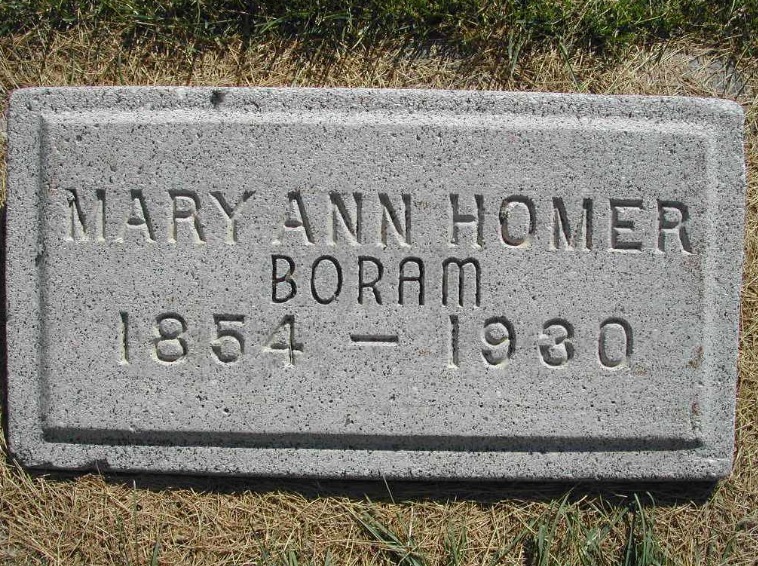
Her friends were legion, and they all keenly mourned her loss, but felt that there must be great rejoicing on the other side to welcome back such a splendid and unusual spirit who had so enriched this world by being here. She was a woman of brilliant mind, a profound student of her associates and their ways of life, which gave her a deep and genuine understanding and affection for her fellow men.