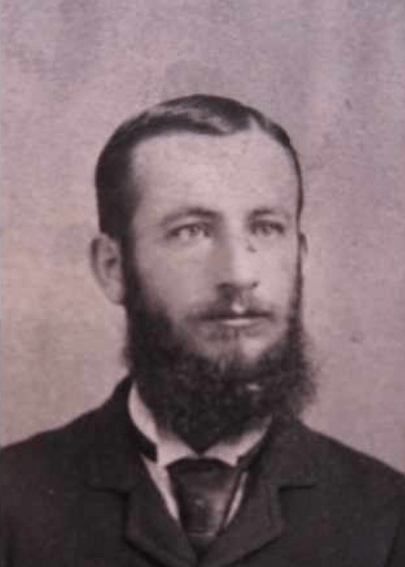
Joshua “T” Homer1
Joshua Homer was the second child of Russell King Homer and Eliza Thornton, born at Salt Lake City, February 3, 1863. Being the oldest boy of that family and in fact the only boy until just before his mother’s death, his mother and his Grandfather Thornton made a great deal of him. His Grandfather Thornton was particularly proud of “Jossie Lad” as he called him, and talked about what a good, bright man he would be some day.
As elsewhere related, his mother died at Swan Lake in February, 1873, leaving six small children, whereupon that family was taken to live with mother Homer at 3-Mile Creek. There, Joshua first began to attend school. His first teacher was John Peters, later a well-known pioneer and religious worker of Brigham City. During his boyhood, he had many interesting experiences of pioneer life, such as one would expect any boy of that time to have. These experiences were similar to the ones related elsewhere in this book when he saved his sister Ginnie from drowning in the spring by grasping her hair and holding her until help came; and the time when he
and Adelia Petty carried his baby brother David about ten miles through the mud, late at night, because the bridge at Cub River was out. Such experiences were common in the pioneer days because of the problems which were always present in overcoming the forces of nature and subduing the country.
At the time the Homer family moved to Clarkston, Joshua was 12 years old, which was then considered old enough to do practically a man’s work, and carry serious responsibilities in all of the family endeavors. He helped in getting timber out of the canyons, building buildings breaking up land, and doing all kinds of outdoor work. When oxen were used as teams either for plowing or hauling loads, it took one man to manage the plow or the load and the other to walk alongside and manage the oxen. Joshua’s Job as a boy was to walk by the oxen and drive them. This was accomplished by the use of a whip-lash braided out of buckskin with which he was very dexterous. Evenings and rainy days would be spend braiding his new whips. He made bullets for their guns with a hand-made pair of bullet molds. He had a large spoon in which to melt the lead and pewter over the kitchen fire from which the bullets were molded. From the pine logs, he got pine gum which he brought home and melted for chewing gum for all the kids in the neighborhood.
Joshua was a very bright and studious boy in school, interested in practically all subjects. He and his pal, E. Z. Carbine, prided themselves that they could solve all of the problems in Ray’s arithmetic, and they were the only boys around who could do it.
Joshua, after the manner of his family, became accomplished in the art of telling stories in the evening by means of which he entertained the smaller children. One evening when he was so engaged and all of the children were gathered around the fire, his sister Beckie went to take a kettle of boiling water for the dishes and accidentally spilled it on Joshua’s foot. He had on a heavy shoe and a thick woolen sock. He began to scream like bedlam, and jump around but the kids were all excited and didn’t know what to do except run for father, which Beckie did like a streak. When father got there, Joshua’s foot was almost cooked, so he had to go to school all winter on crutches.
Joshua finished grade school in Clarkston, and, together with his pal, E. Z. Carbine, went to Brigham Young College in Logan. When he was 19, he went to Gentile Valley They were snowed in where he taught school that winter. practically the entire time, having mail carried in on snow
On December 7, 1887, he was married to Olena Jensen in the Logan Temple. Just a few days afterwards, he departed on a mission to the Southern States. He enjoyed his missionary work in Maryland, Virginia, and West Virginia very much, and acquired a strong testimony of the Gospel which stayed with him throughout his life. After he had been on his mission 21 months, his father became desperately ill, and it was feared that he would die before Joshua could return. The Church gave him an honorable release, and he arrived back home just prior to his father’s death.
Thereafter, he began teaching the public school in Clarkston. All of the children in town of school age were taught in one room in an ungraded school. At times he had as many as 86 pupils. He also homesteaded a dry farm near Clarkston. In the year 1896, he and his wife and their two children, Nels and Wendell, sold their place at Clarkston to Allan Archibald and went to Parker, Idaho. At first they lived with his sister, Rebecca Costley, who had previously gone there, while Joshua got out the logs and built them a log room to live in. They were pioneering that part of the country, and lived through the hardships of building their own home and clearing the sagebrush off the land to raise their crops. By fall he had completed three log rooms and harvested a crop of wheat. Their log house had a dirt roof. The first winter was a long and hard one. The snow melting from the roof ran in streams on the inside of the whitewashed walls. Joshua and his cousin lined the walls with factory cloth much to the joy of his wife; he completed this just before she gave birth to their third son Donald on March 14, 1897. He also taught the public school at Parker that year, and was superintendent of the Young Men’s Mutual Improvement Association. He was interested in all Church activities, and during the next five years served as superintendent of Sunday School, and Stake Instructor for Religion Class. In September, 1897, he was set apart as President of the 113th Quorum of Seventies of the L.D.S. Church by Seymour B. Young.
Politically, Joshua was a democrat. He was somewhat interested in politics and ran for State Senator. Although Democrats were very much in the minority and out of control of politics there at the time, he was defeated by a very small margin, which was a source of pride and satisfaction to him. He became manager of a cooperative store at Parker, and prospered to the extent that he was able to build a good home for his family.
He and his son Nels both began to be troubled with asthma. The winters were so cold and there was so much harsh wind there that they finally decided to get back down to Utah where the climate was somewhat milder. In the year 1902, he traded his property in Parker for a farm in Far West, Weber County. He and his family were admitted to membership in that ward, April 13, 1902. In spite of the move, however, he continued to suffer from asthma during the remainder of his life. Late in 1906, they decided to spend the winter in St. George, Utah to see if that would benefit his health. Accompanied by his wife and a new baby son, Melvin, they travelled to Modena by railway, only to find that the stage went to St. George just twice a week. There were three other passengers with them when the stage finally left. The road was so rough and sandy that many places on the trip they had to get out and push the wagon through the sand. This long, tiresome trip over that primitive road seems a long time away from the modern ribbons of pavement over which we zip with such speed today. During that winter, Joshua did work for 361 dead people in the St. George Temple.
Like his father before him, he was quite interested in dry He tried to get his own boys and some of the neighbors started dry farming in the central part of Box- This had not been done before in that area. Many people thought the attempt was foolish. It finally succeeded, however, and the land is now profitably producing thousands of bushels of wheat by dry farming.
In 1912, he ran for the school Board from the 4th district, and was elected. There was not one vote cast against him in his own town. On October 10, 1917, Governor Simon Bamberger appointed him Judge of the Juvenile Court in Ogden, in which position he served two terms. Being very much interested in human beings and their problems, he thoroughly enjoyed this experience.
During the time he lived at Far West, he kept up his interest in the Church and took a course in genealogy under Nephi Anderson. This course aroused his interest in genealogy, and thereafter he spent a great amount of time working on the genealogical and Temple work of his own people.
September 10, 1917, his son, Joshua Wendell, was drafted into the army of the United States, being among the first boys to leave Weber County. He was with the famous 91st Division of the United States Army in France, fighting in the San Michiel and the Argonne forests, but he returned safely home in May of 1919.
In 1919 he found himself with a family of grown sons, and not sufficient land or interests near him to occupy them, so he arranged a trade of his Far West property for 320 acres of land at Point Lookout just west of Tremonton in Boxelder County. A good deal of this land was irrigated and required lots of work and attention. He thought this would be sufficient for all his sons to make a living and be near him.
Joshua had a sense of responsibility for the welfare of all his kindred which grew out of his deep love for them. He used to talk about how happy he was when his baby brother Dave was brought to live with mother Homer. He remembered that Dave had on a red dress and Joshua thought he was the best looking little boy
he had ever seen. After his marriage, Dave spent considerable time at his home until he moved to Parker, Idaho. When Joshua was not too sick to be concerned about such things, he was full of hope, and planning for the good of his family. His interests, however, did not stop with his own family. Nothing afforded him greater pleasure than to be able to lend a helping hand to any friend or neighbor or wayfarer who might come along in need of assistance.
During the later years of his life, he enjoyed going from Tremonton over to Logan to work in the Temple. He was recognized by all who knew him to be a man of unusual character and mental attainments. It seems a queer quirk of fortune that a man of such ability, courage, and ambitions as he had should have been restricted in his endeavors by such an ailment; however, his life certainly was successful when measured by true standards. He discharged all responsibilities placed upon him, and was true to every trust that was given him. Notwithstanding any misfortune that befell him, he was steadfast in his faith in the Gospel he believed in. He was a full and honest tithe payer to the Church, and taught his children to revere and honor their religion. He died November 18, 1921 and is buried at Tremonton.
His family is as follows:
| Nels Russell Homer | Tessie Wiseman |
| Joshua Wendell Homer | Sadie Heins |
| Donald J. Homer | Esma Taylor & Laverne Hill |
| Leland Vernal Homer | Died unmarried |
| Ella Eliza Homer | Lorin Farr |
| Melvin W. Homer | Sara Somers & Grace Thompson |
| Edmund “Z” Homer | Lyle Sarah Cutler Homer |
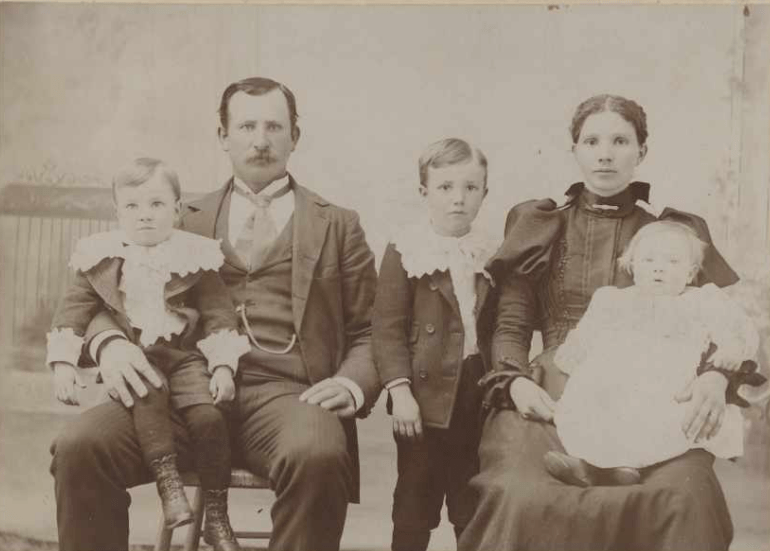
From left to right:
Joshua Wendell Homer, Joshua “T” Homer, Nels Russell Homer, Olena Jensen, Donald Jensen Homer
Image Source: https://www.familysearch.org/en/tree/person/memories/KWC2-QFQ
(1) The “T” does not stand for anything. According to my father Grant Homer and his sister Mary Homer Olsen, who are Joshua’s Grandson and Granddaughter, Joshua only had the middle initial T. His Mother came up with the idea of giving them just an initial that sounded good, (as with Edmund Z Homer, the Z does NOT stand for Zebulon or any other Z name you might think of.) This tradition only applied to Joshua and to Edmund and did not go further.

