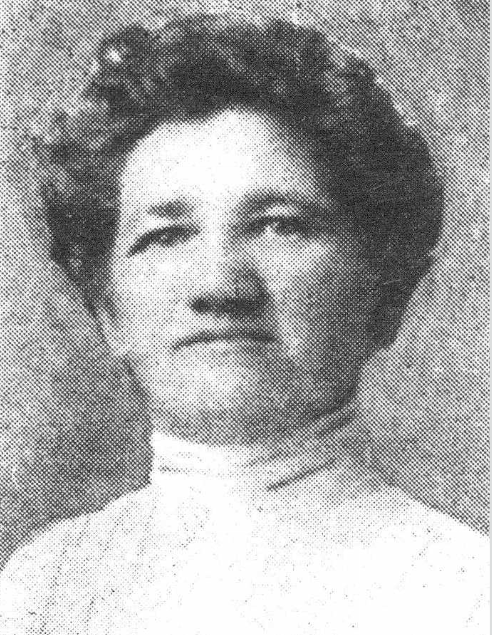
Delania Anderson Homer Cooper
R. M. H. CROCKETT
The second child of Russell King and Mary Caroline Anderson Homer was born at Salt Lake City, February 9, 1863. She was almost four years old when the great misfortune of having her mother die occurred. She was taken to Three-Mile Creek in Boxelder County to live with her stepmother, Eliza Thornton Homer, and her family. She was of a loving and sunny disposition, so she got on well with her new mother and her children. Her father took her, together with other children of the family, on his occasional trips to Salt Lake City. These trips were the real high-lights of her childhood. She remembers well the life and circumstances described in this book in the history of Eliza Thornton Homer—the Indians, the travelers who stopped at their home, the grasshoppers, and the crickets. Vivid in her memory is the fact that in spite of all the drouth and insects and the multitude of tasks her stepmother had to cope with, she also managed to raise a few old-fashioned flowers in the yard. On Sunday mornings, when the children were already for Sunday School, if they had been good all week, mother pinned on them a flower as a reward for their good conduct. They then walked three miles to the church.
As “Lanie” grew up, she was always of a cheerful and agreeable disposition, so she had no trouble getting along with her elders. She was very fond of babies and seemed destined to do a lot of baby tending. At the age of 8, she went to live with an elder sister Lovisa and her husband Charles Thornton in Smithfield. She assisted with the work of their home and children, making her home with them for the next eight years. They then moved from Smithfield to Utah’s Dixie, in accordance with a call from the Church Authorities to help pioneer that part of the country. They located right near the mouth of Zion’s Canyon at a place called “Springdale.” They saw and became well acquainted with the wonders of Zion’s Canyon and that portion of the country long before the general public knew anything about them. There they suffered many privations in this new undeveloped country so far from any town or market. There were no roads nor bridges nor irrigation systems developed. They had to get along on what they could produce themselves, or do without it. The climate was such that they could not produce proper foods to give them a balanced diet. Most of them were in poor health a good deal of the time, having chills and fever, sore eyes, and other ailments. During her young womanhood there, Lanie was undernourished and ill, but nevertheless had to work hard to assist in the endeavor to succeed. They raised principally fruit which had to be picked, cut and dried, as they had no other means of preserving it. They raised some cotton; all of the work in connection with it had to be done by hand.
However, Lanie was a young girl, and she and the other young people of that locality managed to get in some good times at their Church socials and picnics. They also did a good deal of exploring the wonders of the nearby canyons. In this very hot climate, they had poor water and no refrigeration at all, so in spite of all of the help that father Homer was able to send them, they decided to give it up and come “back North.
Lanie returned to Clarkston, which had become the Homer family home by that time. She was then a young woman, and, although she did not enjoy the best of health, she was always in good spirits and ready for fun. She went to school some, and helped out her married brothers and sisters when it was necessary.
The Year she was 20 Years old, she met a handsome young man by the name of William Cooper. To her he was “one and only.” She felt that all of her girlhood dreams of romance had come true. After a few months of courtship, they were married on February 28, 1884 at Clarkston, leaving immediately to make their home in Oxford, Idaho. There first three children— Wyley, Homer, and Della were born at Oxford. After they had resided there for six years, they took up a homestead on the Portneuf River, just above where the town of Lava Hot Springs now stands. This was new, rugged country, and, like her sisters and brothers in other parts of southern Idaho, she lived the real pioneering life. Hard work and perseverance provided them with a good home and living. Their son Fontain was born there on the ranch. When it came time to put the older children in a higher school than was provided in that locality, Lanie moved to Logan and entered them in the Agricultural College, while her husband stayed on the ranch to take care of it. For several years, they rented a home and lived in Logan. Wyley graduated from the College, but soon after his graduation became afflicted with rheumatism, and, after a long illness, died at the age of 26. This seemed to take the zest out of life for them, and their home did not seem the same.
They then moved to Pocatello, Idaho where her husband ran for and was elected to the office of County Sheriff, in which office he served several terms. Thereafter he worked on the Pocatello city police force as long as he was able to work. During his latter years, he became ill and was an invalid for fifteen years. He died September 4, 1934 just after their Golden Wedding Anniversary, which they were unable to celebrate because of his illness.
The next winter, Lanie went to California and spent the winter in and around Pasadena resting, visiting, and seeing many things of interest; it was her first trip to the Coast.
She and her sister Maretta were both there that winter. They had a number of relatives and dear old friends to Visit, and they had a very pleasant winter together.
Upon her return home, she resolved to make her home at Lava Hot Springs with her daughter Della, and to visit around with her sons and sisters. As she had no particular responsibilities to tie her down, this program seemed very enjoyable. In November of 1935, she went to Twin Falls to spend the winter with Fontain and his wife and daughter. A few days after her arrival there, a great tragedy occurred. Fontain, who was a State Highway Patrolman for the State of Idaho, was assisting in the apprehension and arrest of a desperado by the name of Von Flack who had murdered his wife; Fontain was shot and killed. This was a terrible shock to Lanie and grieved her so much that her health and spirits suffered greatly for a long time.
She is at present comfortably and pleasantly situated at Lava Hot Springs. Her children and grandchildren are devoted to her and look after her ever v need. She is one of the oldest and best known pioneers and residents in that part of Idaho. She is almost 80 years of age, and she still has the charming and delightful personality which has always been hers. A joy of living and a love for everyone has always emanated from her, and so she has been loved respected by all who knew her. It is a great pleasure to her to see others, especially children, enjoying life. She still gets a thrill out of good books, good shows, and going to church. She has always been and still is a member in good standing in the Mormon Church, which has been a very Important factor in her life.
Her children are as follows:
| William Wyley Cooper | |
| Mary Delania Cooper | Married to Thomas Edgar Phelps |
| Homer Dwight Cooper | Married to Alice Fern Sharp |
| Oscar Fontaine Cooper | Married to Emma Perkins or Baker |
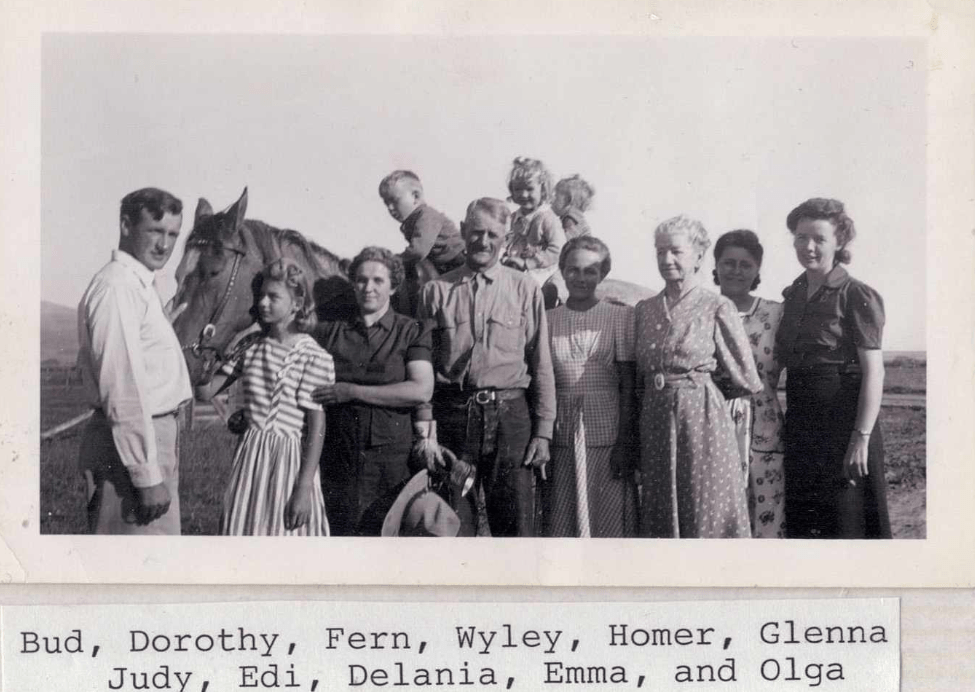
From left to right
Harold (Bud) Wyley Cooper, Dorothy Cooper Swainston, Alice Fern Sharp, Wyley Cooper, Dwight Homer Cooper, Judy Cooper, Delania Homer Cooper, Emma Cooper, Olga Berg
Image Source: https://www.familysearch.org/en/tree/person/memories/KWVC-9NQ

