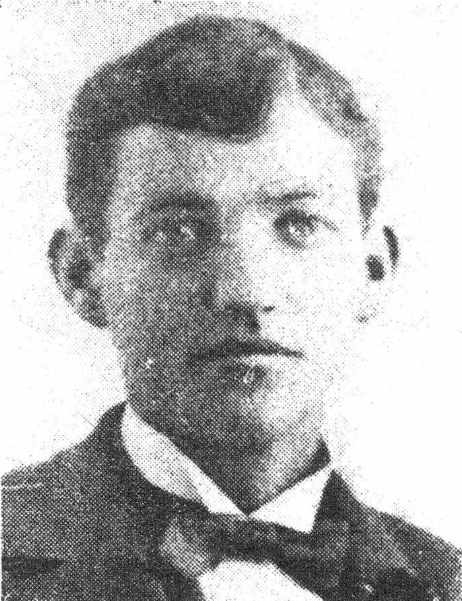
David T. Homer
BY RACHEL M. H. CROCKETT
One of the most loving and lovable characters it has ever been my pleasure to know was my baby brother, Dave, youngest son of Russell K. and Eliza Thornton Homer. Having suffered the great misfortune of losing his mother when he was but one month old, he had a hard time getting a start in life. During his first two years, he had a number of different homes as there were some who were willing to take him, but none who really wanted him.
In those times of stress and hard work, without any conveniences, when everything had to be done the hard way, a bottle fed baby was a real problem. The only way of feeding such a baby was with a home-made nursing bottle connected out of a chicken feather quill wrapped with white rags which were very scarce. Such a method of feeding, coupled with the fact that so little was known of sanitation at that time, naturally caused him to be very often upset in his digestion, which made
a real job for those who had him in charge. His older sister, Sarah, was kept right with him wherever he went. She was just the right age for a baby tender. By the time he came to mother Homer’s in Three-Mile Creek, he was drinking milk out of a cup. At milking time he was right on hand, where the milking was being done, with his cup to have it filled up right from the source of supply.
One morning Dave and our pet colt, Roscoe, were out in back drinking their milk. Roscoe was standing on the ground drinking out of a bucket on the porch. He spilled some on the floor. Dave went and got the mop and was Wiping it up. Roscoe didn’t seem to like this, so he just reached over and picked up Dave by the hair of his head and gave him a good shaking and sat him down again on the
At that time, it was customary to keep boys in dresses until they were three or four years old and to let their hair grow. Dave had a head of heavy, dark, curly hair which he wore in a big curl on top of his head. He was surely a cute little boy. I remember his first trousers and red-top boots, and how he danced the sailor’s hornpipe and the double shuffle in them.
We entertained so many travelers, horse buyers, and cattle men as they came by that Dave was almost kept busy dancing. He had a small tin bank full of nickels and dimes which they gave him for performing.
Dave was fond of pet animals. He always had a dog. Every spring as the sheep herds went through town, he managed some way or other to get someone to give him a motherless lamb to raise which he named “Millie” or “Billy,” according to its sex. Pretty soon the lamb would be tagging along behind Dave with his dog. The summer he was eleven years old, he was sent to herd horses on the washboard hills north of Clarkston. Having quite a bit of leisure time, he took occasion to go swimming in Big Creek with every boy that came along. He caught a bad cold which turned into a bad bronchial cough from which he never recovered.
At the age of thirteen, father took him to Malad to take treatment from Dr. Drake, who was the family friend and doctor. Dr. Drake advised leaving him there so he could be under supervision. He made his home with the Drake family for two years, going to school when he felt able. He took up marble playing in earnest, and became quite expert at it. The boys called him “the marble merchant” because he won so many marbles and sold them back to other boys. One day a Mr. Williams made complaint to the doctor about Dave winning so many marbles from his son. The doctor said, “Why don’t you play him yourself?” Mr. Williams indignantly replied that he would “and show that young man how to play marbles.” The next day quite a crowd had assembled to see the game. Mr. Williams came with a goodly supply of marbles. Dave won them all, much to the amusement of the spectators.
After he had been in Malad two years, Dave’s father died and he came back to Clarkston. When mother Homer went to live at Rigby, Dave spent one winter up there, but could not stand the severe climate. He came back to Clarkston and lived a while each with Rinda, Josh, Beckie, and Sarah. As he grew to young manhood, he was always in poor health. His bronchial cough had developed into rather severe asthma. He was thin and pale, but he had large dark blue eyes and black hair which was inclined to be wavy.
Despite his ailment, he was of a cheerful personality, always ready to tell or listen to a good joke. He had to be very careful about any kind of exertion, but he loved to sing and dance. He was a good sport and popular with the boys and girls of his own age who were always in for a good time. Not long ago a woman who could remember him as a young man told me: “Dave Homer was the handsomest, cleverest, and most charming young man I ever knew.
He had a fine team of driving horses and a handsome buggy, which he enjoyed driving about. He loved to take people who seldom got out for a ride. These horses were so well trained and attached to him that they seemed to understand every word he said. One day while he was driving out on Newton hill, he came across an Indian who had had some trouble by being thrown from his horse. His clothes were so badly torn that he did not dare to come out of the fields. When Dave saw his predicament, he took off his overalls and gave them to the Indian, coming home in his own underwear.
Politically he was a Democrat, and, although he never actively participated, he was very much interested in politics. I remember that he bet a team and saddle pony on William J. Bryan in the election of 1896.
Dave continued to take treatments from various doctors, but none of them seemed to give him any permanent relief from his ailment. A young doctor Ormsby came to Logan and built up quite a reputation because of some cures he performed. Dave went to him and was persuaded to remain in Logan to take constant treatments. At that time my husband had recently died, and I wanted to make some plan for the future. Dave and I made plans to establish a home in Logan. I was to take up nursing and obstetrics with Dr. Parkinson, and Dave was to be there where he could take his treatments.
One morning the first part of October, 1897, Dave went to the blacksmith shop where the men of the town customarily gathered to gossip. He began to feel quite tired and for a while sat down on some lumber in the sun; then he went home. We sent for the doctor He recommended that Dave leave there immediately for a warmer climate to spend the winter, preferably to Pasadena which was then considered quite a health resort. Our old hired boy, Will Hanson, who had been faithful to father for so long and who was with him during his last illness, offered to go and take care of Dave through the winter. We began making preparations for them to go. Dave was suddenly stricken with pneumonia. He died October 26, 1897 at his sister Sarah’s home in Clarkston where he is buried.
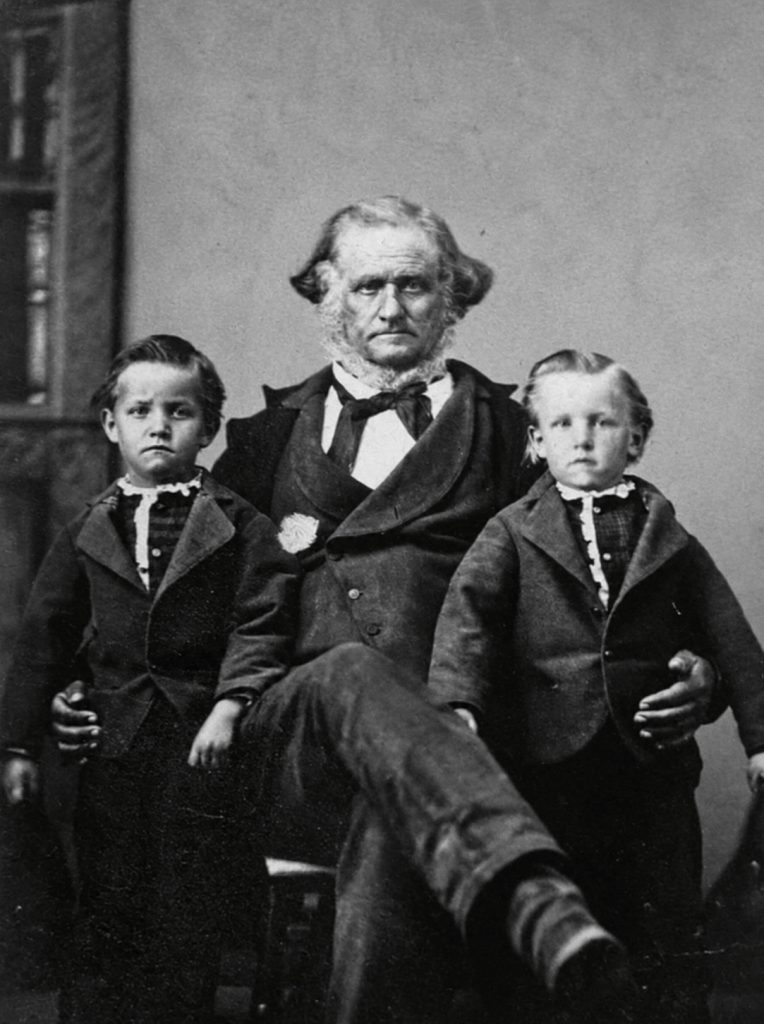
From left to right: David Homer, Russell King Homer, Parley Pratt Homer
Image Sources: https://www.familysearch.org/en/tree/person/memories/KWVL-6H9

