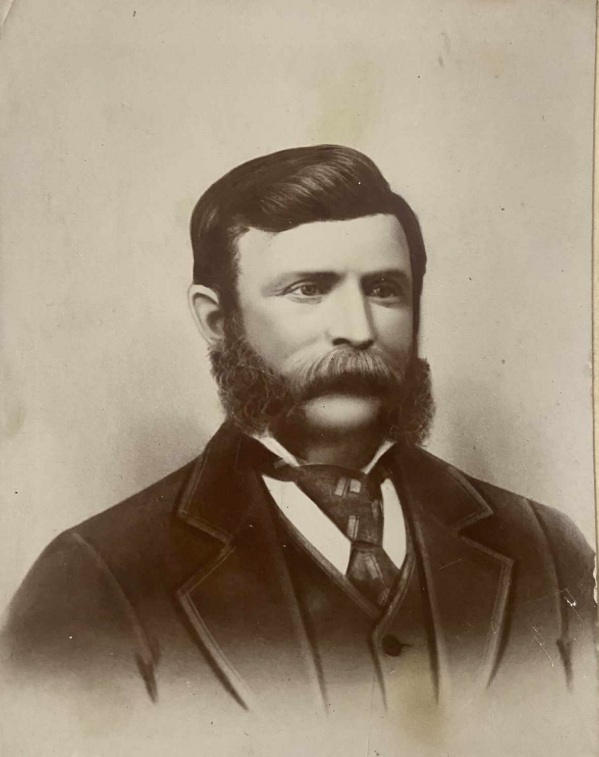
Benjamin John Homer
BY R. M. H. CROCKETT
The 3rd son of Eliza Williamson and Russell K. Homer was born in Coneaut, Pennsylvania on February 1, 1853. He was named Benjamin John after his two grandfathers, Benjamin Cobb Homer and John Williamson. He was always known by his second name of John. John’s father was on a temporary sojourn in
Pennsylvania at that time, settling up the estate of Benjamin Cobb Homer. After this business was completed that spring, the family returned to Iowa where the next five years of Benjamin John Homer’s life was spent.
He was only five years of age when his parents and family crossed the Plains from Iowa to Salt Lake City in the wagon train, the account of which is related in more detail in the other histories in this volume. He was old enough however, to remember something of this trip.
After the family were settled in Salt Lake City, his father established a cattle ranch at Packer’s Bridge, Idaho. At a very early age, John began to go up there during summer vacations to help with the ranch work and care for the cattle. One day while roping a calf, he was jerked off his horse and dragged for a ways which resulted in his receiving a rather severe injury that somewhat affected his health for the rest of his life; although he was not an invalid, he was not in robust health from that time on. As he neared young manhood, he spent more and more of his time with the cattle in Idaho, making only occasional trips back to visit with the family.
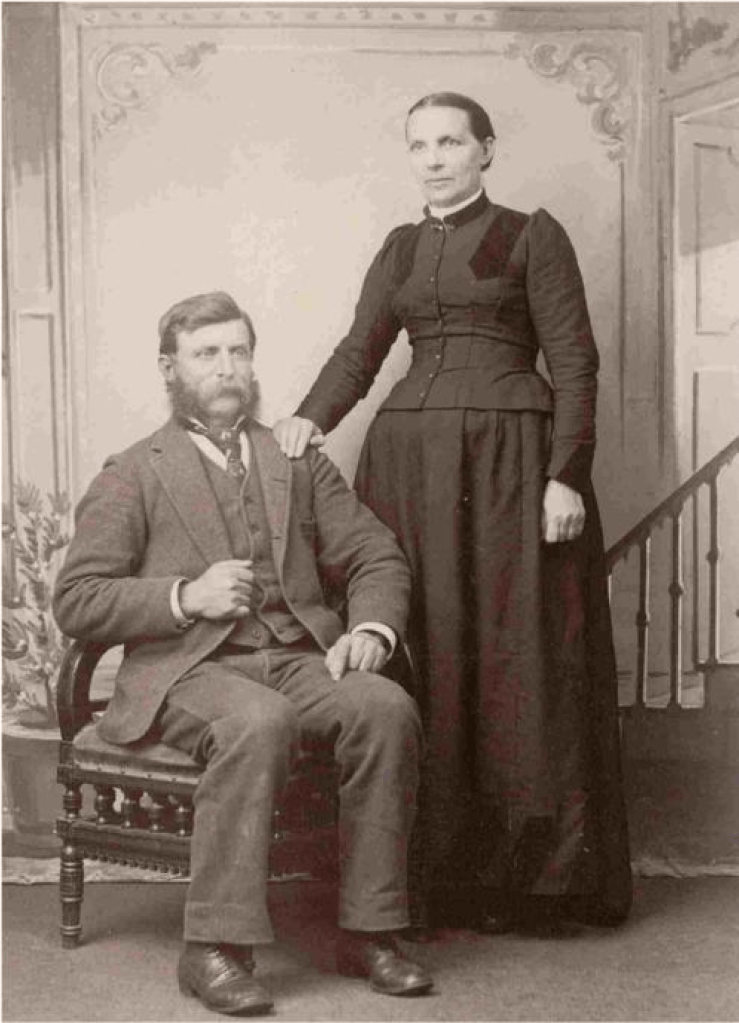
A young lady, Mary Adelia Petty, came up there as a hired girl to help with the dairy work. Upon her arrival, it was necessary for her to cross the river in a boat. John took the boat over to get her. When he saw a fine looking young woman waiting for a boat ride across the river, he thought it presented an opportunity to have some fun by giving her a good scare. She apprehended this from the mischievous twinkle in his eye, and decided that she would make it interesting for him by just not being scared; so he proceeded to cut up a few daring capers with the boat, but she held to her determination and took it like a good soldier. This was the beginning of a beautiful romance between them which incidentally included many boat rides on the same river by moonlight. She worked for one year there before going to live with her uncle, William Carbine, in Clarkston in order to prepare a trousseau and get ready to be married. On Christmas day, 1873, they were married by her uncle at his home in Clarkston, after which they returned to Oxford, where John’s father then had a ranch.
For a time, he continued to work for his father. After father Homer sold his place in Oxford and moved his cattle to Clarkston, John and Adelia also moved there and continued with the same work.
He and his father became interested in mining, and John worked at the hauling of supplies, cooking, and general management and overseeing of the mining work. About 1880, they decided to begin farming for themselves, so John and his brother Edmund rented the Goodwin brothers’ ranch near Trenton. Soon thereafter, John bought his own ranch at Trenton. This is the same property on which his daughter, Nellie and son-in-law, William B. Sparkes now live and which is known as the “Sparks’ Ranch.’
They were blessed with a large family of eight sons and four daughters. The parents had a special aptitude for placing responsibilities upon their children, so that each had his own duties and his own privileges and knew what they were. Although the children were well disciplined and well behaved, they never knew what licking” was. If they misbehaved or deserved censure, their father used to say to them humorously, “if you aren’t careful, I’ll send you up to
………………………. (one of the neighbors who was notorious for “licking” his children) “to get your licking.” It was never necessary to carry out this threat. Their home, its organization and management, and the good will and contentment which resulted from its well-planned arrangement was one of the best the writer has ever known and it was always well supplied with good books, magazines, and newspapers to provide proper interest and activities for the family.
When they began farming, they had the same problems and hardships which others of that time encountered, living a real pioneering life in building up and establishing their home. In order to get the materials for buildings, fencing, and otherwise improving the farm, John procured employment in Malad as County Jailer. He worked at this for several years, leaving the family at home to care for the ranch most of the time.
John was known as a good husband, father, and neighbor. He was especially fond of animals.
He used to keep a number of black cats which would crawl all over him and sit on his shoulders. They also followed him to milk the cows, and sat upon their haunches while he milked in their mouths.
John had the largest dog I ever saw. He named him Beecher for everyday use but Henry Ward Beecher for Sunday. The dog was strictly a one-man dog and very savage. John kept him with him when he worked at the Jail and felt perfectly safe as the toughest Guy did not care for any trouble with the dog. When he quit working at the jail and came home he had to give the dog away as he was too savage to keep around home. John gave him to a young woman who lived alone on a ranch where he was very much appreciated and found a good home.
John died at the age of 43 leaving nine children to the care of his wife who was not in the best of health. The eldest of the children was nineteen and the youngest a few months.
However, she unselfishly and courageously undertook this tremendous task of rearing the family and did it very successfully. When her baby boy (Joseph) was overseas in the first World War she laid down her burdens and passed on to a well-earned rest.
Their Children:
| William Harrison Homer | EIlen Grace Harper |
| Benjamin Petty Homer | Anettie Smith |
| John Albert Homer | Bartha May Pullum |
| Mary Adelia Homer | Died young |
| Nellie Maud Homer | William Buttars Sparkes |
| Russel King Horner | Minnie Sorensen |
| Eleanor E. Homer | Archie John Harper |
| Francis Homer | Elleanor Bell Chesmore |
| Robert Earl Homer | Died young |
| James Edgar Homer | Ida Janet Bird |
| Rosetta Homer | Died young |
| Joseph Petty Homer | Reta Fearn Brough |

