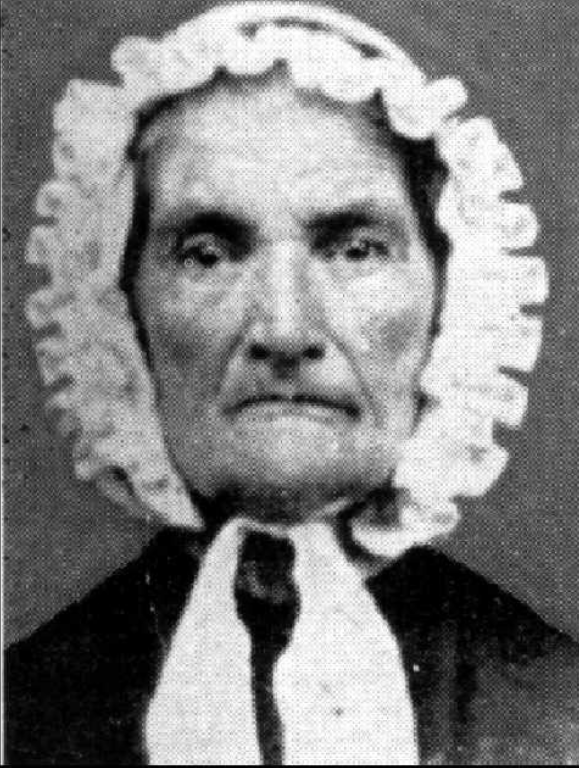
Anna Warner Homer

Anna Warner[1], whose great-grandmother was an Indian princess of the Cherokee nation, ‘possessed some characteristics which suggested that ancestry. She had black eyes and hair as black as midnight. She was physically strong and energetic and capable of doing the strenuous work that fell to the lot of the pioneer mother of her time. She evidently came from very hardy stock, her own grandmother lived to be 113 years of age; eight of her nine children were born here in this home. In rearing this family, her duties were so numerous that they required her to be active from early morning to late at night every day. They included the shearing of the sheep; the washing and carding of the Wool; the spinning of the yarn and weaving it into cloth, or knitting it into stockings and mittens for the use of the family. She was almost always occupied with part of this task while she sat with the family around the huge fireplace which was in one end of the living room. This fireplace was the center of the family life. It must always be kept plentifully supplied with logs from the woods nearby. All of the cooking was done over it, and it was the only source of light and heat. Grandmother was learned far beyond the average woman of her time, and as the family sat around the fireplace in the winter evenings while she knit and sewed, she taught her family to read and write. She had few books except the family Bible, and this they learned to recite almost from cover to cover. She sang to them and they sang together songs and ballads, as well as gospel hymns. She told them many stories of early American history and of folk lore and Indian legends. One of her self-imposed duties was that of maternity nurse for the scattered neighborhood. Any time of day or night or any season of the year, she always responded to any call where she was needed. Sometimes she went through narrow trails, through the woods in the storms or blizzards to attend to someone who needed her assistance.

She had a deeply religious nature, and was a very devout Methodist. Grandfather called them the “ranting, roaring Methodists,” as they took their religion seriously, and, while preaching and praying, made a lot of noise. Once every summer she took a vacation and left her family home and cares to her old uncle, Caleb Warner, who made his home with them. He was a veteran of the Revolutionary War, and was past doing hard work, so during his later years, he lived with the Homers and helped grandmother with her many cares, especially in tending the children. So during her religious vacation each summer for a week or two, he took care of the household while she went to the camp meeting or revival that was held somewhere in the vicinity of their home in the woods.

The eight children who were born to them in this home in Onondaga County were as follows: Joshua, William Warner, Elizabeth, Aseneth Allen, Russell King, Delania, Julia Caroline, and Esther. Benjamin Thomas, their youngest son, was born in Ridgeway County, New York.

Joshua, their eldest boy, left home when he was 20 years old, and they never saw or heard of him afterward. Much speculation as to where he had gone was indulged in, and for years every effort was made to locate him, but his disappearance is a mystery that has never been solved.

Soon after this happened, the family decided to move to Pennsylvania as they thought there was a better climate there, and it was a more thickly inhabited part of the country. Once again, they located on a piece of timberland and began clearing timber and building a new home and planting crops. This was in Crawford County. Benjamin Homer was getting along in years and his health would not permit him to do the hard labor he had previously been able to do. His sons were fairly well grown and able to take over the more difficult phases of the work. He then turned his attention to the thing he had always wanted to do—the rearing and caring for good horses. He soon had some very fine stock which he advertised by exhibiting at the various county fairs. By a careful selection of his stock, honest dealing, and strict attention to these pursuits, he built up a thriving business and a good reputation as an authority on all questions pertaining to horses. After his death, his son, William W. Homer, took over and for many years carried on this business.

An interesting sidelight on this history is found in the following story: After Benjamin Cobb Homer’s death, father Homer went back to Pennsylvania to look after his estate. He found that he had inherited his father’s favorite mare “Bett.” As she was very old and not able to make the trip to Iowa, he was obliged to leave her in Pennsylvania with his brother. Fifty years later while his son William H. Homer was living in Oxford, Idaho, he and a man named Natt Ireland sent to Kentucky for a thoroughbred stallion. When the horse arrived and they were looking over his pedigree, they found that one of his ancestry had been this mare “Bett,” bred and owned by Benjamin C. Homer of Crawford County, Pennsylvania.

The fifth child of this family was the Russell King Homer referred to at the beginning of this history, and my father. Father lived the life of any average pioneer boy in these surroundings. When he was about 15 years old, he and some boy friends were riding on horseback in the woods, going nowhere in particular. They saw a man coming towards them on horseback. As he approached, they saw that he was a very handsome man on a magnificent black horse, and his whole appearance was so striking that they were amazed. It looked as if he sat in the air above the horse. When he came even with the boys, he halted and asked for direction to a place nearby. Father answered and gave him directions. The stranger then asked, “My boy, what is your name?” Father answered, “My name is Russell Homer.” The stranger then said, “My name is Joseph Smith and my Boy, you will join the church that has just been organized, and go with the Saints to the Rocky Mountains and stand up and bear your testimony to the truthfulness of the everlasting gospel.” Father had no idea what he was talking about, but it made a deep impression upon him and was never forgotten. He related the incident many times, and people now living have heard father bear this testimony.

In some spots in the locality where they lived, human bones were to be found strewn over the ground. It was supposed that they were the bones of Indians that had been killed in wars before the advent of white men into that part of New York. These bones which father and his play mates played with later became important to him in his conversion to Mormonism.

One of the near neighbors to the Homers in Onondaga County was the Williamson family. They had a daughter Eliza born the same year as Russell King. As their parents were friends and neighbors, these two were childhood sweethearts. When the Homers went to Crawford County.

Pennsylvania, the Williamsons went with them, and the families located near each other. The two children were 15 years old, and their youthful romance continued. In the summer of 1836, Eliza returned to New York to visit with old friends and was gone some months when she sent word to her mother that she was homesick and would like to come back to Pennsylvania. Her mother, Mrs. Williamson, reported this to the Homer family and asked Russell how he would like to go and get her. He replied that he did not know of anything he would like better if he could bring a wife back with him. To this Mrs. Williamson graciously responded that she did not know of anything she would like better for a Christmas present than to have him for a son-in-law. I have heard father tell of how, when he began this journey, he was as proud as a gallant knight of old setting out to rescue his lady fair and bring her back to a home of her own. Before he started, he procured some elegant clothes, a swallow-tailed coat and a fine linen shirt with a frilled bosom, a high stove-pipe hat, knee breeches, and high-top boots.

They were married December 20, 1836, at Erie, New York, and spent the holidays

honeymooning in and around that city. They rode on the first steamboat which had sailed on Lake Erie. Father spent all of his money, and had to sell his new boots to get sufficient money to complete the journey home.

Their first home was a log cabin built in the woods from logs cut from the clearing where the house stood. The furnishings were homemade of the same materials; these furnishings consisted mainly of a hewn table, stools, and bed. The house had the family fireplace with a big iron pot and a bake oven for cooking purposes. As they had no matches, the starting of a fire was quite a job, and they tried to keep it going at all times. On one occasion, father went seven miles on foot through the woods to get a start of fire, and carried it home in the iron pot, keeping it alive all the way by occasionally replenishing it.

Many breath-taking stories are told of their experiences when they lived in this wilderness. They often had to build fires to keep wild animals away from their clearing, especially when they had young animals around, or had killed fresh meat of any kind. Then they had to watch the fire all night to keep it from spreading. They lived in this home for several years and their first two children were born there. The first, Elizabeth, only lived a few days, then came Edmund, their oldest son.

An unusual experience came to them just three weeks before Edmund was born. Father went out early one morning to do his chores and heard a faint cry coming from the manger. He was greatly surprised to find a baby boy, apparently about ten days old, completely clothed and wrapped in a blanket. At his side was a note appealing to the one who found him, stating that he was born in wedlock but his father was dead and his mother unable to care for him; that she had other children, and if the baby was well treated she would never interfere or try to claim him. The note also contained his name—Edson White. They were really pleased with the new boy and began to hope their own would be a boy so they could pass for twins and when theirs came, they called him “Edmund” so they would have twin names. When Edson was about three months old, 8 young man and woman came inquiring about him and convinced the Homers that the young woman was the mother of the child and the young man was her brother Her story was that she had been engaged to marry the child’s father and that he had lived on the opposite side of a wide river from her home. They were to have been married on a certain day, but the water was high and swift and he was drowned attempting to come across for the wedding. The young man with her had been away from home until recently and knew nothing of his sister’s trouble, but protested his desire to do his duty by his sister’s child and raise and educate him. The Homers were very much attached to the child and it was with great sorrow that they finally agreed to give him up to his true mother who had proper credentials and gave a notarized receipt for the child

While they were living in Pennsylvania, a stranger came along and asked father for a night’s lodging. Father readily welcomed him and went out to help him unhitch and care for his team. The man took a book out of his wagon and said, “I think your name is Homer. Here is a book your friend Martin Harris sent you.” As father took the book in his hand, a voice said distinctly in his ear, “That is a history of those bones you used to play with.” Surprised, he looked around and could see no one. He was sure it was not the man who presented the book and neither of them had seen anyone else. This book was the BOOK OF MORMON. Father was deeply impressed by this experience, and related it in many times in connection with his testimony of the Gospel. The next day he started to read is and the more he read the more interested he became. When he had finished it, he was convinced that it was the true history of the American Indians and also that it contained the fullness of the Everlasting Gospel. This he firmly believed to the last day of his life.

He immediately began to get anxious to get to the headquarters of the Mormon Church, which at that time was in Kirtland, Ohio. He began trying to persuade his wife, and her sister, and her sister’s husband, Dr. Libeus Coon, to go with him to Kirtland. They were mot much interested in this new religion, but reluctantly consented to go with him. When they arrived there, church was in session and the Prophet Joseph Smith himself was speaking. He mentioned the poverty of the Church, and said that some funds were needed immediately. After the session, he came down through the congregation shaking hands. He neared father, and Martin Harris stepped forward to introduce them. As father shook his hand, he left a $10 gold piece in it. The Prophet looked at the money and said, “Mr. Homer, money was never needed worse or put to a better use than this will be. This is indeed ‘bread cast upon the waters’ and will be returned to you and yours. Neither you nor your family shall ever want for bread.” Father was so impressed with what he heard that he would not leave the room to get lunch for fear he might not get back in time for the next session. He drank in every word and wished to get baptized before he left Kirtland, but the others were not so impressed. They were devout members of the Dutch Church and were quite satisfied with their religion. Father returned home without doing anything about joining the Church.

At that time, the tide of emigration was moving westward to Ohio and Illinois. In the spring of 1840, to quote father’s own words, he got a bad case of “western fever” He said he was tired of living where he had to chop clown trees to see the sun rise, and he thought they could find better opportunities in the new western country- so they loaded their few belongings in a covered wagon and started west. They lived for some time in Logan County, Illinois, where their next two children Nancy and Anna, were born.

The Mormons by this time had established the city of Nauvoo, Illinois, and father determined to go there as was really interested in the Mormon people and their doctrines. As they were travelling westward, they camped near the present site of Springfield, Illinois, where the next son, William Harrison, was born in the covered wagon. Father had taken the initial steps toward becoming a Free Mason but gave it up soon after joining the Mormon Church and, like his father before him, had never belonged to any church, but was thoroughly converted to the Gospel as taught by the Mormons that he persistently urged his wife Eliza to join him in becoming a member of the Mormon Church, but he didn’t want to join it without her. She remained faithful to the Dutch Church, and insisted that she had no wish to change, but in the year 1844 she suffered a severe sick spell and was administered to by Mormon elders, after which she rapidly regained her health. This caused her to change her mind about the religion, and she was baptized and confirmed a member in the Mormon Church before father was. He was baptized in the Nauvoo Temple March 21, 1844. The Prophet Joseph Smith said he had been converted for so long and done so much to help the Church that he was worthy to be ordained to the higher Priesthood, so he was ordained an Elder the same day. Later in his life, he said he wished he had held the Aaronic Priesthood, if for only a short time, as he felt as though he had missed something.

They now both embraced the Gospel with firm conviction, and they remained steadfast and faithful to it from then on as long as they lived. They cast their lot with the Saints for better or worse and cooperated with them in every way to further the cause of the Church. After the death of the Prophet, they joined the Saints in their Exodus from Nauvoo. They went into Iowa as far as Garden Grove, where they planted crops for those who would come later. They left there and went on to the Missouri River where they stopped among the Pottawattamie Indians. These Indians were friendly and gave them corn, beans melons and other foods. Father left his family there and went to Missouri to work, husking corn to get supplies for his own family and others whose fathers and husbands had gone with the Mormon Battalion. He husked corn and cut cordwood and received corn for his pay.

When the Pioneers of 1847 were preparing to leave for the west, father took teams, wagons, and supplies for himself and his neighbor, Almon Williams, and went to headquarters, prepared to go with the Saints. They were much longer getting ready that was at first expected. After two weeks of waiting, President Kimball came to him and said, “Brother Homer, you are just the man we need to stay here and look after the Church cattle. Your family are sick and need you, so you better let Brother Williams take your outfit across and you stay here. We want you to inspect every animal that starts across, and make sure it is able to stand the trip.” This plan was followed. Brother Williams drove father’s outfit across, and returned them to the satisfaction of all concerned. Father took over the management of the Church cattle, and supervised the outfitting of all emigrants that left there during the next two years. Many emigrants did not have sufficient money to buy proper outfits, but he managed to find ways for them to travel, or sold them cattle and supplies on credit. Father also established a ferry across the Missouri River for carrying passengers and freight. It consisted of flat-boats propelled by oars. This was the only means of crossing for several years.

In this business, he became personally acquainted with many people, and, at times, handled quite large sums of money. Once, just after a large company had left he was informed by a friendly Indian that a plot was on, foot to rob him. He filled a money belt with several pounds of gold, the proceeds of his business, and swam the Missouri River in the dark of night with this money. I have heard him say that he just slid into the water and lay on his back and swam quietly across to the opposite shore, landing a half mile down the river in a safe place and returned without having been missed.

In father’s later life in Utah, it was a source of great joy to him to meet people with whom he had dealt in this business. Many of them came and thanked him and expressed their appreciation for the good turn he had done them by selling them cattle that were sound and able to stand the trip. When he settled in Clarkston in his later life, Bishop Jardine of the ward there was one of these persons. His face shone with pleasure as he met father and he remarked, “Why, Brother Homer, you are the man who sold us the cattle that brought us across the Plains. I had worked in the coal mines in Scotland all my life and had just come to America. I hardly knew a cow from a horse, and could so easily have been duped, but that yoke of cattle served us well for the trip and for many years after we were located in Wellsville.”

Their next move was to a small village on the bank of the Missouri River, where they started a mercantile business and traded with emigrants, Indians, trappers and hunters. They also kept the post office. On January 20, 1848, Russell K. Homer applied by petition for a post office for the town of Winter Quarters.

Father had acquired the services of a hired man, a faithful Indian whom they called Kudjo, and he was very devoted to Father. His job was to herd the Church cattle. The cattle were grazing across a wide stream from where the house stood. For a long time there had been renegade white men stealing range cattle and horses in such a manner as to let it appear that it had been done by Indians. One story that is told about this Kudjo seems quite unbelievable, but it has been known and retold ever since that time in the Homer family.

One day when Kudjo was herding cattle, two white men jumped out from behind a tree and grabbed his horse by the bits. Kudjo put his arms around the horse’s neck and put up a terrific fight to keep the horse. He told the men “This is Homer’s horse and you can’t have him, even if you take everything of mine,” and he held on to the horse’s neck while they tried by every means to make him let go. They took the saddle and bridle and even took Kudjo’s clothing, but he still hung onto the horse. It was cold, but late that night Kudjo brought the horse home without even a rope on it. He was entirely nude and snow covered the ground.

While living at that place two more daughters were born to the Homers, Lovisa Matilda and Julia Carolyn.

In the Church Historian’s Office of the L. D. S. Church, there is a Daily Journal History of the activities of the Saints. In this history I have found numerous items referring to Russell K. Homer; one of them is substantially as follows:

“On January 24, 1849, Shadrack Roundy, Russell K. Homer, Jedediah M. Grant, G. D. Grant, and J. S. Fullmer organized a company for the purpose of carrying persons and goods from the Missouri River to Sutters Fort in California. This company was called ‘The Great Salt Lake Carrying Company.’ They would guarantee to furnish the very best in transportation that was to be had; good teams, reliable teamsters and light spring wagons, each wagon to carry three besides the teamster, and each passenger allowed 150 pounds of baggage. One of the owners would be in Salt Lake to relay with fresh horses and supplies. The fare per person was $100 to Salt Lake City, or $300 to Sutters Fort to be paid in advance. The freight trains would carry freight at the rate of $12.50 cwt., two-thirds in advance.”

This company was in business for some years while the gold rush to California was on and people were coming from all over the world smitten by gold fever, caring not for the cost but being concerned only with their haste to get there. An account of this carrying company is mentioned in Bancroft’s History of Utah. In the spring of 1849, Russell K. Homer signed a contract to haul freight for Livingston and Kinkaid, merchants who were to open the first general merchandise store in Salt Lake City. Accordingly, he loaded seven prairie schooners with goods. He took with him a crew of eight men, one of them being his brother, Ben Homer. They left early in the spring for Salt Lake City, expecting to return to Iowa in the fall. At first they made very good time, but practically all the men contracted cholera from which they all recovered. However, they had quite a difficult time getting the goods delivered on time. All of the teams and wagons and the entire outfit were Father Homer’s, so when he had finished his business in Salt Lake City, he sold them there and they returned by saddle pony and pack mule. ln the return company were quite a number of Church people; Orson Hyde was starting on his first mission to Palestine, and Orson Pratt was going to New York on business for the Church. They were later than had been expected getting started, so somewhere in Nebraska they were caught in a terrible blizzard which held them up for several days. Father caught a severe cold which developed into pneumonia. Fortunately, they came to an old abandoned hut, where he lay very ill for several days. Finally, he arrived home weak and ill after the winter had set in.

The following is also from the journal History in the Church Historian’s Office:

“Russell Homer and his brother Ben Homer were with our Company returning home after delivering goods to Mr. Kinkaid, a merchant of St. Louis, Missouri, who was starting a mercantile business in Salt Lake City. We were caught in a most terrible blizzard that lasted several days. He and his brother had started out with eight horses and finally reached the Missouri river with one horse. On account of bad storms, the company had been separated, some going ahead several different times. All of the men got through but most all the stock perished.”

Father and Uncle Ben were the last ones to get back to Iowa. In the spring of 1852, Father received word that his Father, Benjamin Cobb Homer, had died in Pennsylvania and that Father had been named executor of his estate. He felt that he had to give this matter his personal attention and he also had a desire to see the relatives and old friends back in Pennsylvania. He sold out all his holdings in Iowa and took his family by team back to Pennsylvania. He arranged a proper settlement of the estate by acquiring the land from the rest of the heirs and having it deeded to his mother Anna Warner Homer and Elizabeth Homer Rice, his oldest sister who was then a widow. His mother lived there for some years in the old home, but the last few years of her life were spent with her daughter, Julia Homer Crockett.

Upon their arrival in Pennsylvania, they were very much surprised to find that they were not the only ones who had taken up a new religion. Their relatives and many of their friends in Pennsylvania were interested in Spiritualism at that time, and were anxious to convert Father Homer to that cult. Father and Mother refused to investigate or become interested, but there were spiritualistic demonstrations going on around the house so frequently that the children were afraid to go upstairs to bed. One morning about three o’clock, Father was awakened by rappings apparently near his bed. There would be three sharp raps then an interval of silence and three more raps, and so on. Father raised up in bed and shouted so he could be heard throughout the whole house, “If you are the Lord, rap on; if you are the Devil be gone.” That seemed to put to rest the spiritual demonstrations.

On February 1st, 1853 their son Benjamin John Homer was born in the old family home in Crawford County, Pennsylvania.

The folks in Pennsylvania were very prejudiced against the Mormons, so they never did come to an understanding about religion. His mother, Anna Warner, remained true to her Methodist faith as long as she lived. Father’s brother Ben homer, who came to Iowa and worked with Father, finally joined the Re-Organized (Josephite) Church. One of Mother Homer’s brother, Chauncy Williamson, also came to Iowa and joined the Re-organized (Josephite) Church.

Father thought that Iowa was the garden spot of the world and used to say that nothing but religion would have induced him to leave there. He tried to persuade his people to come west as far as Iowa but was unable to do so as they seemed satisfied to remain in Pennsylvania. Father and his family bid them goodbye again for what they felt sure would be the last time, and turned their faces westward. They did bring with them Mother Homer’s mother. Nancy Williamson, who was a widow, consented to come although she never became interested in the religion. They first went to Buffalo and took passage on a steam boat to Cleveland, Ohio, where they bought teams and equipment to travel back to Iowa. Upon their arrival in Iowa, Father took up a homestead on Pigeon Creek, 13 miles north of Council Bluff. They improved this land and entered into the business of buying and selling hogs, which proved to be a profitable enterprise. After proving up on the homestead they moved into Crescent City in Iowa and opened up a real estate office and a hotel. The hotel was called the Homer House and it soon became well known, as Mother Homer was a good cook and so famous for her pies and doughnuts that travelers went miles out of their way to get some of her food.

Many of their patrons were Indians who lived on the opposite side of the river. On several occasions when a large number were across on their side, such heavy storms came up the water was lashed into a fury and it was not safe for them to go back in their light canoes. Mother asked them to remain all night and while she took her children in her room and went to bed and slept all night, the dining room and kitchen floors were covered with drunken Indians wrapped in their blankets and no white Tan around the place but she was not afraid. She said, why should I be afraid, I was their friend and they knew it and not one of them but would have defended me against any danger.”

The Homer House entertained all missionaries free of charge as they passed by there either going to their fields of labor or returning home. During the winter of 1857-58, all missionaries were called home on account of the Johnston’s Army episode. Fifty of them sat down at the Homer table at one time without anything being asked for their keep. Sixteen missionaries were too late to go with the last company across the Plains and stayed with the Homers all winter. They were: Henry Yates, John Wakley, Milo and James Andrus, Benjamin Cluff, Samuel Atkins,

James Gleason, Ephraim Hanks, George Goddard, Charles and Andrew Shumway, Sam Ritter, Abram O. Smoot, Brothers Lee, Felshaw, and Brooks. Eliza did their laundry, mending, and darning besides keeping and boarding them all winter. Father found ways for all of them to cross the Plains at the earliest opportunity. Some of them were to work their way as teamsters and help in other capacities in companies going to Great Salt Lake Valley. Father had a valuable horse that he loaned Brother Lee to ride across, with the understanding that he would care for the horse and turn him over to father when he got here. Father also outfitted one wagon with two mares and two horses; five of these men, including Abram O. Smoot, who was in charge, were to come with that rig. The understanding was that Brother Smoot was to take charge of the horses and care for and return them with half of their increase when father got to Utah.

During the time spent at the Homer House, two more daughters were born—Mary Ann and Rosetta Katherine. Grandmother Williamson and little daughter Julia died there. Father continued in the ferry and freighting business, leaving the management of the store and hotel to the members of the family. Whenever they employed extra help, they tried to give the work to someone anxious to set across to Utah. They had much honest and sincere help and friendship from the Indians. In spite of all they did for others, they prospered and became well off. One of Father’s sayings was: “You will not lose anything by helping a person who is putting forth an honest effort to help himself.”

In the summer of 1858, an independent company of emigrants and returning missionaries was organized to leave Florence, Nebraska, for Salt Lake City; of that company, Russell K. Homer was captain and Christian Felsted was chaplain and president. The company left for Utah July 5, 1858. It was in this company that the Homer family crossed the Plains. The family was well equipped with conveniences for camping. They had tents, a camp stove, a light spring wagon for the family, and had three additional wagons loaded with their effects and two loaded with merchandise they were freighting for merchants in Utah. They also drove with them a bunch of loose stock consisting of horses, mules, and cattle. The rest of the company was mostly from Denmark. They were also pretty well equipped, all having pretty good outfits and their own supplies. Early in the journey, they came to some high water, but ferried across in tight wagon boxes which were built tight for just such an emergency.

They made good time all the way and saw hundreds of loaded wagons hauling supplies for Johnston’s Army which had gone on the year before. One of the boys, William H. Homer, who was 12 years at the time, reports in his diary the following incident:

“On one occasion we seemed about to meet our fate at the hands of Sioux Indians on the warpath. Decked out in their war paint and feathers, a band of these fierce-looking fellows swooped down upon us about four o’clock in the afternoon, circling around our wagon train. Captain Homer, understanding the situation, called all the teams to a halt and sent out a man with a white flag to meet them. They kept coming closer whooping and yelling, until they were quite close to the man with the flag, when their chieftain held up his hand and they all stopped. He came forward alone on a beautiful white pony; he spoke to the man with the flag, and after a brief conversation asked to talk to the big white chief. After very impressive preparations, Father went out to meet the Indian chief, who demanded great quantities of flour, sugar, tobacco, and beef cattle. After some time spent in partying, they agreed to settle for a much smaller amount and various trinkets—beads, mirrors, bandanna handkerchiefs, etc. The chief, very gratified, then said, I see you are peaceful travelers wishing to pass through our country, and we will make a dance in your honor,’ which they did. When all matters were satisfactorily settled, the chief took father to one side and said, ‘There are hostile tribes of Indians ahead watching for wagon trains, and if the great white chief so desires, we will go along to protect your company; however, we would prefer to keep out of sight, but would see that no harm came to the white chief and his friends.’ This offer was gladly accepted and he kept his word. We caught glimpses of them in the distance for a few days, but they did not come near us; and that was the last of our Indian troubles.

“At the crossing of the Green River, we camped near the tents of that famous scout and trapper, Jim Bridger. With Father, I visited his tents and saw his two Indian wives, and played with his children while father traded horses with the illustrious Jim Bridger.

“One night when we camped on Wood River, near its junction with the Platte, we had just got our cook tent pitched when it started to rain. How it poured down; accompanied by fierce thunder and lightning! Everybody rushed for cover; sixteen crowded into our tent. Mother was near the stove cooking; 1 was on the ground behind the stove. I heard a heavy clap of thunder, and the next thing I knew was next day we were traveling along in the wagon. Mother told me how the tent had been struck and everybody in it stunned. I was the last to come to. Mother was the worst injured; she was badly burned about her feet and legs, her shoes were torn off and her clothing was torn and burned.”

They traveled as fast as their teams could stand, stopping only for the regular Sunday rest. They made what was considered very good time all the way, and on October 7, 1858, arrived in Salt Lake City. They drove up in front of Samuel Corbett’s house in the Second Ward, and turned their stock loose to eat the grass off the street. In the Journal Histories in the Church Historian’s Office, the following item is found: “Captain Russell Homer landed in Salt Lake City with a train of wagons, October 7, 1858.”

Upon their arrival in Utah, there were many friends who came to greet them, bid them welcome, and to offer any kind of assistance; among them, many of the persons they had helped to get across the Plains. One of the first of these was John Wakley. He was so thrilled to see them that he embraced Father and literally cried with joy, and said, “Russ, everything I have in this world is yours, even to the shirt on my back.” Upon being told they were not in need of help, he replied, “Well, there is one thing 1 can and will do,” and in spite of protests, he took their tired and worn out horses and exchanged them for his own which were in excellent condition. Henry Lee came to father and said, “1 still have your horse. He is yours, but I won’t return him this time of year. 1 will feed him until spring and bring him to you.” Of course there were many others who had received help from them who had already located and begun to prosper and had apparently forgotten all about them.

They rented a house in the Seventeenth Ward for the first winter. In the spring, Father bought a home in the Second Ward and moved into it. It was necessary for Father to make another trip to Iowa to dispose of the last of his property there. In the spring, he took his oldest son Edmund with him, planning to attend to his own affairs and bring a train of emigrants on the return trip. They left Eliza, with the help of one hired man, to look after the stock and the family, and made the trip to Iowa the summer of 1859. During that summer, Eliza Homer’s last child, Russell King Homer, Jr., was born. On the return journey, father was the captain of another wagon train which was made up mostly of Scandinavian people. They were mostly poor people whom the Church had helped in furnishing with the necessary wagons to haul their small belongings and enough provisions to last them on the way; they were not nearly as well equipped as the company he had piloted across the year before. Each wagon was loaded with as much as it was considered safe for it to carry without breaking down, and it was necessary for most of these people to walk the entire distance.

Father, as captain, led the train with a light spring wagon and a team of horses. Four women rode with him. Edmund drove oxen on wagons loaded with goods. On this trip, father brought more supplies for his family, including a large full-sized mirror, some silk for mother, Nancy, Anna, and Lovisa each a dress, together with some lace window curtains, fine linen table-cloths, a china dinner set, some sugar, a five-pound caddy of tea, and a beautiful Brussels carpet.

All of these things were certainly rare luxuries for that time and place, and Eliza Homer always took great pride in them.

These Scandinavian immigrants were earnest, hardy, and industrious people. They earned father’s everlasting respect for the way they bore their burdens and hardships on this journey.

He always said that he did not know of any people who had the actual physical endurance of some of the Scandinavians he knew.

Among those who set out to walk was a young woman who was not well. She had a hard time keeping up all the way. Her husband was a teamster, so was too busy to give her much attention, but her father helped her along and kept up her morale, until one morning she was taken severely ill just as all was in readiness for starting. The whole company was held up while she gave birth to a child. No provision had been made for her to ride, and the teamsters were uneasy to get on the way. Father fixed her a bed in one of his wagons on top of some kegs of nails, where she was permitted to ride until someone else needed it worse. She jolted along there for a week when another member of the company needed the place. She said she could walk if she did not have to carry the baby. Russell took the tools out of the jockey box, built a little extension on it, and put the baby in it, where it jolted along in perfect safety. When they were stopping over one Sunday, the young woman said, “Captain Homer, I know I can never repay you for what you have done for me and my baby, but I would like you to name the baby for me.” There was nothing Father would rather do than name a baby, so he replied, “I would consider it an honor and a pleasure. We will just name the baby after her mother.” Dortea was her name.

In the Journal Histories of the Church Historian’s Office is the following item: “October 19, 1859, Captain Russell Homer with a wagon train from the Missouri River is a few days late, but expected to arrive any time.” the company arrived in Salt Lake City the same date as the above item, and that was Russell’s last trip across the Plains. For several years thereafter, he sent teams and wagons back and forth across the Plains with two of his sons and two of his sons-inlaw, in connection with freighting merchandise and helping the Saints coming to Utah.

The next happenings in the Homer family warrant some explanation, as it is difficult for people of today to understand the reasons for polygamy, and the circumstances out of which it arose. As is the case with nearly all religious denominations, the Mormon Church had a majority of women members. Brigham Young said that there were a lot of women in Utah who had left their homes and people, and that every normal woman should have the privilege of having a husband and children if she so desired. He also stated that if the Mormon settlement was to be successful and prosperous that a new generation of people should grow up here. The Mormon Church did sanction polygamy for those who were considered worthy to live in plural marriage, but a man had to be a clean-living man in full fellowship and good standing in the Church and financially able to provide for the extra members of his family. He must also be willing to accept the responsibilities attendant upon such marriages, and give the plural wives and their children the same status as the rest of his family, both in the family itself and before the rest of the world. Father filled all of these requirements and was advised to marry in polygamy. As it was in accordance with the teachings of the Church and not forbidden by the laws of the land, he did so. Soon after getting settled in Salt Lake, he married Mary Anderson and Eliza Thornton. A detailed story of their personal histories is included in this volume, which sets forth how they were taken into and became a part of the family and, in turn, gave birth to families of their own, all of which fused into the whole family unit.

Father lost no time in beginning to pioneer new districts in northern Utah and southern Idaho. He first took up a place at Peoria on the Weber River, and served as the first justice of the peace in that part of the country. He then took up some land and settled a place in what is now Gentile Valley. He and a man by the name of Fellows were the first white men settling there. It was so isolated and the snow fell so deep, they were snowed in for months at a time, so Father brought his family away, leaving Mr. Fellows there. He was not a Church member and the valley came to be known as “Gentile Valley.” Father also settled a place at Three-Mile Creek just south of Brigham, and there established the family home with mother (Eliza Thornton) and her family. He also, pioneered a place at Swan Lake and another at Packer’s Bridge which was on the Bear

River near where the town of Preston now stands. The Eliza Thornton family lived at Packer’s Bridge and at Swan Lake for about three years. The birth of her sixth child occurred in midwinter when the snow was deep and it was impossible to get a doctor to attend her; there was none available nearer than Salt Lake. She was attended by a mid-wife, but developed pneumonia after the birth and passed away, leaving the baby and five other children. This was indeed a serious situation, so he turned to the partner he had known since childhood and took this family of six children to her as soon as the winter broke to permit the trip. They were many days on the way, encountering high water in many places where there were no bridges and other places where the bridges were washed out. When they came to Cub River a few miles north of Richmond, it was dark and raining and the bridge was washed out. They were all damp and hungry. The supply of milk for the three-months old had run out. Father used an old tin lantern we had along to light the way in the darkness ahead of the horses. As they approached the stream, he saw that the bridge was gone, but a new one had been started and there were enough planks across the framework so that it was possible to crawl across to the other side. It was decided that Josh, who was 10 years old, and a young woman, Adelia Petty, whom Father had procured to take care of the baby, would crawl across the bridge and take the baby to Richmond on foot, while the rest of them would have to stay there until morning. They got across the stream and trudged along in the sticky mud through the rain, arriving at Richmond about midnight, where they found a welcome refuge in the home of Louis Petty, who was a brother to the young woman. (This young lady, soon after that episode, married our brother, John Homer.) The next morning early, men came to work on the bridge. They took the wagon to pieces, rolled the wheels across one at a time, then ferried the wagon box across the water. Father carried the children across the planks on his shoulders. As they were passing Wellsville Creek two days later— Father had rolled the wagon cover back so the children could get the sun—Sarah rolled off the back of the wagon into the creek. She was soaked through and her nose was bleeding. She had to be stripped down and wrapped in a blanket.

It was still very cold weather and the mountains ahead of them were full of snow. Father managed all these things in his stride, and they finally got to Three-Mile Creek and mother Homer. If she was not happy to see him and the extra burdens he brought with him, she didn’t say so. She kissed each one of them and gave them a good warm supper and put them to bed in a cozy warm bed. What a haven this was to the poor wayfarers who had been so long in the mud and rain!

Mother Homer was not given to making a fuss over anybody; however, her attitude was that Father Homer was and always had been “her man” and his burdens were her burdens and his children were her children. She took this family of motherless children to her bosom and treated them just like they were her own. They never could have told from any word or conduct of hers that they weren’t exactly the same as her natural children.

After planting crops in Three-Mile Creek that spring, Father set out to find a place where he could get the family altogether and be near them all. He found on the west side of Cache Valley at Clarkston just what he had been looking for, a good market for draught horses and Oats. It was a wonderful grass country where you could raise cattle and horses and mow wild hay most anywhere; it was also on the main freight trail from Corinne to Helena. They were also happy to find there some of their old friends and neighbors from Iowa. These people were the Henry Yates and James Myler families.

About the first of April, 1875, all of the Homers’ goods and chattels were loaded in four wagons ready to start for Clarkston. The sun was shining when they left Three-Mile Creek, but by the time they got to Deweyville, there was a blizzard blowing. They were held up there for two days; they camped in the school house. Father broiled beef on top of the box stove. He would lay a piece on the stove, sear it, sprinkle it with salt and pepper, and turn it over to sear the other side, while the children stood by with a slice of bread ready to put it on. In the evening, the young people of the town came and brought music. They danced and sang and had a grand time with the young folks.

The third morning the blizzard abated some so that they got under way again. When they came to the Clarkston Divide, Father said that everyone able would have to walk except mother and the baby, Dave. Rinda, who was 14 years old and Rachel, trudged up the hill together, but soon got lost. Rinda sheltered Rachel under her shawl and kept lugging her up the hill. Soon one of the teamsters came back and found them. The snow was so deep on the Clarkston side that the wagons would not roll, so Father sent one of the men into town for help. Several sleighs came out to meet them. They drove into town right over the top of the fences on the crusted snow.

A few years before this move to Clarkston, Father had married his fourth and last wife. Aunt Prianna. She and her family were established in a home in Clarkston. The autumn of 1874, upon the Homers’ arrival there, she had a large iron pot of beans and bacon cooking over a fireplace for them. Father had traded his homes in Three-Mile Creek with two Clarkston men, George Davis and John Dunn. The Homers moved into their homes and were all one big happy family there in Clarkston, making free to go back and forth whenever they felt inclined.

Father was quite interested in mining as a side line. He expended a lot of money and fruitless effort in mining in Ogden Canyon, only to have the mines fill up with water. At Clarkston, he also had expert miners and prospectors do a lot of work for him, which ventures likewise failed. Meanwhile, he kept acquiring more land and more cattle and buying and selling horses, and experimenting in dry farming. He said where wheat grass would grow wheat would grow without irrigation and decided to try dry farming. At first he broke up land and experimented with spring wheat, but the season was not long enough, so the wheat was usually caught by an early fall frost. He sent to New Zealand for a sample of hard winter or fall wheat. It was just a small package of four pounds. He let Brother Andrew Heggie, a resident of Clarkston, have part of it, and he planted the rest. It matured all right, so Father nursed it along and gradually let others have the seed. The raising of this fall wheat has become one of the principal industries in that part of the country, and has brought comfort and independence to many who were poor prior to its advent here. Father considered this one of the real achievements of his lifetime. He also spent a great deal of money trying out new types of farm machinery to determine the most suitable ones for use in that locality. He lived to see good crops of fall wheat grown and harvested with the header. One season he raised four thousand bushels of this wheat on Newton Hill; he sold this wheat for 40 cents a bushel.

In addition to his many other interests, Father, like his father before him, was the physician and surgeon, bone setter, and veterinary for all those living near him.

It is appropriate to include in this book something of the home life of Father Homer’s family in Clarkston. Father had stopped freighting and settled down to living at home all the time, except for business trips to Logan and an occasional trip to Salt Lake. I (Rachel) recall him going to the funeral of Brigham Young and taking his son Josh with him. They travelled by team, taking several days to make the trip. Upon their return, he brought everyone in the family material for a new dress, shawls for the older girls, and some fine wool material called “water proof” capes for we younger girls. Our sister Mary made us all beautiful dresses and some of us hoods and capes by hand from these materials.

From the time I first remember, our home was a gathering place for the young people of the town. They came early in the evening, played games, sang and danced, and went home early. Mother would not allow card playing nor allow anyone to stay late, but she enjoyed seeing young people have a good time, and didn’t at all mind the noise of the fun and frolic which it seems was going on most every evening at our home.

Like the home of everyone’s childhood, that dear old home brings up fond memories to all of us Homer children. It was the typical western farm home of the time with its cows and horses, chickens, and all the usual farm animals. We had a well from which we got our water, and what a thrill we got when father brought home a nice new rope with a bucket on each end, together with a pulley arrangement to draw water up out of the well. We thought this was the very last word in modern conveniences. Then there was the well-filled cellar with its apples, potatoes, and vegetables in the fall and winter months, and the back kitchen with cured meats, hams, bacon, corned beef, mincemeat, pickled pork, and lard; a barrel of salted cucumbers, a box of home-made tallow candles, barrel of sauerkraut, cookies and doughnuts.

Our beds were entirely homemade. The quilts were pieced out of strips of the best parts of worn-out clothing; the blankets were made of wool that was washed, corded, spun, and woven by hand, while the pillows were likewise home made from the feathers off wild game and chickens. Rag rugs carpeted most of the floors. Our soap we made out of grease scraps and lye taken from wood ashes. Of course our butter, bread, and other foods were home made in the good old-fashioned way. Father took wheat to the mill and waited for his share of the flour after it was ground. We made hot biscuits of buttermilk and soda, knowing nothing of baking powder. Mother sometimes made salt-rising bread. She raised it with something she called “emptings,” a mixture of flour and salt.

Mother used to make hats for all the family out of cloth or out of straw which she braided herself. She would bleach the straw or color it. She also colored the home-spun yarn with home-made dyes. She colored black with logwood, yellow with onion peel, orange with copperas, pink with aniline, blue with indigo, and red with madder. She also made starch from grated raw potatoes.

Father bought three stoves of the first shipment of stoves that ever came to Utah. He gave Nancy and Anna each one for presents and mother had one for the home in Clarkston.

The mail came from Logan twice a week, but sometimes when we were snowed in in the winter, we would not see mail for several weeks. Father took two newspapers— the NEW YORK WORLD and POMEROY’S DEMOCRAT, which was published in St. Louis. Bishop Jardine took the Deseret News. Just as soon as they had each read their own paper, they exchanged and read the other one. Mother always took the WOMAN’S EXPONENT for herself and the JUVENILE INSTRUCTOR, which was published by our Church in Salt Lake City, for the children. Father often read aloud to the entire family, but he would not read nor permit us to read novels or fairy tales. This was no doubt because of the strict Methodist upbringing his mother, Anna Warner, had given him. We were practically raised on Benjamin Franklin’s Maxims.

We had no modern plumbing and no steam heat, refrigeration, or even screens; yet it was a comfortable home, and living in it provided us with a richness of life such as is known in few homes of today.

About ten years before his death, Father bought a light spring wagon or buggy. He drove around the country a great deal, always managing to take a load of his family with him. We were the envy of the other children in the town because we got to travel around so much, and it certainly made us feel very important. His was the only buggy in town that could be borrowed on any terms, so it went somewhere every day. It seemed that practically every morning while we were at breakfast, someone would come in and ask “Brother Homer” if he was going to use his buggy that day. Unless he had definite plans to use it, his reply would be something like this: “Oh, I don’t know; what are you intending to do?” The neighbor would likely respond that he was going to Logan or somewhere else and could get along without taking a heavy wagon. To this father would reply, “Well, I guess you better take it. You are the first on docket this morning, so go ahead before someone else comes and gets it. Oh, yes, be sure you grease it before you start, and do that before you leave here so I will be sure it’s done.” Did this gruff permission turn away any prospective borrower? Not one whit. They all knew “Dad Homer’s bark was worse than his bite.” He used to say that “no” was the hardest word in the English language for him to say. The fact is he seldom, if ever, tried it to see. Not only did he loan the buggy, but most everything else on the place. Anything that anyone asked either father or mother for they usually got. She would even lend the last loaf of bread in her house and then make biscuits for her own family.

Father had a great liking for trading horses, and, like David Harum, seldom got the worst of a horse trade. He generally got or gave some kind of “boot” on the bargain, and that would include anything he had handy—his hat, gloves, boots, pocket knife, or what have you. Mother told that in their early days, she braided and made him a nice straw hat which he threw in on a horse trade and came home bare-headed, and continued to go bare-headed until she had braided him another hat out of straw.

Father was the typical pioneer, usually dressed in the true western style with high-topped boots, red and black checked flannel shirt, pants and vest and wearing a Stetson hat. He had a plain business suit which he wore for church and for very special occasions. He had bright blue eyes that expressed deep understanding or flashed fire as the occasion demanded. His friendly smile was an invitation to friendship. He had a great fondness and affection for children—his own and everyone else’s; the shyest child soon found himself seated upon father’s knee and all his troubles vanished. He was fond of kissing those he loved, not as a mere ceremonial, but in fatherly way of showing affection to them. But with all his loving kindness and consideration for the members of his family, he insisted upon rectitude and propriety in all things. Usually only one look from those flashing blue eyes was enough rebuke for the boldest culprit, while to be left at home from one of those trips was sufficient humiliation for any transgressor. His punishments were those that hurt the ego more than the flesh. His feelings were easily hurt by members of his family. To intentionally hurt his feelings by disobedience was just not to be thought of. His ready kiss with a gentle pat of approval was sufficient reward for any service. His temper was of the flash variety, quickly come and quickly gone, but if by hasty word or action he hurt anyone else’s feelings, he was quick to apologize and make amends. In the evening, the family would gather around him and we would sing the songs his mother taught him and all the church hymns, both Mormon and Methodist, for which he seemed to have an especially good memory. I remember he taught me a ballad of 18 verses when I was four years old. As his children were married and settled down around him, he made it a habit to see those who lived in town every day. If they didn’t come home, he went to see them, if only for a few minutes. Those who lived farther away he saw enough to know at first hand just how they were getting along.

Mother Homer was of an entirely different disposition. Most of the time she was very serious and stern in her demeanor. She ran her household industriously and methodically, assigning certain tasks to the children which must be done in a prompt and orderly fashion. Her life was regulated by the clock. Our mealtime never varied; breakfast was on the table promptly at six a.m., dinner at twelve, and supper at six in the evening, and, though all were welcome, everyone, regardless of name or station, was expected to be at the table on time. She did not use slang or show emotion of any kind. She showed the same courtesy and respect to the humble tramp as she did to the highest personage. She had an unusual sense of justice and fair play for everyone, always seeing to it that the underdog was protected. She dressed plainly; her dresses were all made after one pattern with a tight waist, long sleeves, and a full skirt. She always wore a black lace head dress, only removing it when she combed her hair or put on her bonnet. For dress occasions and church, she wore a black satin dress with white collar and cuffs; an elegant black satin bonnet containing just a touch of white, and wide black satin streamers and an Irish paisley shawl. She had small dainty feet and hands and wore black kid gloves and shoes. She was generous and hospitable with all of the children who visited our home, and saw that they were made welcome. This characteristic is beautifully illustrated in the following incident taken from her story as written by her son, William H. Homer:

“About two years before her death, while mother was visiting at our home in Logan, an old friend came to our house to see mother. They were certainly happy to see each other, and had a nice visit. As he left the house, he shook mother’s hand and with tears in his eyes said, Sister Homer, I do wish to thank you again for your kindness to me when I was a poor, hungry child. We were poor Danish immigrants living in part of your house because we were too poor to pay rent, and you took us in. Every day you gave me one of your big fat biscuits covered with butter. I fancy I can see them yet. I will never forget how good they tasted.”

This is merely an incident which throws some light on her nature. Another little circumstance in which I was the central figure gives further insight into her character. We children were expected to be home for dinner the minute Sunday School was out. Mother was so strict about keeping the Sabbath Day that I was tempted to run away and play with the Buttars girls, which I did. It was dark when I started home thinking of disobeying mother, when I became conscious of the fact that I had practically ruined my new shoes by playing in the wet and mud. I went through much mental agony and tried to clean my shoes and muster up courage to face mother. As I entered the room, she sat reading by the fire; she slowly looked over to me and said, “There’s a piece of chicken left from dinner, I saved for you” and resumed her reading. After I choked the chicken down, I asked mother what could be done about my shoes, and she replied, “You will just have to stay home from the dance and everything else for a week.” That awful week at last came to an end, and I think mother was about as much relieved as I was. When she made a promise, pleasant or unpleasant, she kept her word, and father backed her up.

Mother often took us to shows in the meeting house. She said if it was there, it must be all right, but father’s Methodist upbringing had made him very strongly prejudiced against all public shows. He said people vainly exploited themselves for money, so he would not go to a show of any kind. Well I remember mother taking Beckie and me to the Wellsville Home Dramatic play— EAST LYNNE. How we all laughed and cried and enjoyed ourselves! We dressed and painted up and acted out those parts for years afterwards.

Mother, (Eliza Williamson Homer’s) home was always home for the whole family. Father made it his headquarters and all his business and other activities were carried on from there, and every member of the Homer family, including father and his other wives, called her Mother Homer; and all came home to her when sick or weary or having a burden they needed to share, or a confidence they did not wish betrayed. And she seemed to never tire of serving those she loved.

Mother was very fond of rhymes and stories; she used to spend the long winter evenings by the fire knitting, darning, or doing some other family chores and telling them to us. Promptly at ten minutes to nine every evening she got up, put away her work, moved back the chairs, set the house in order, checked to see if there was water in the bucket and kindling for the fire. She wound the clock and put out the cat and was in bed exactly at nine o’clock.

Father and Mother always enjoyed attending Church. They were honest and conscientious tithe payers and donated to every worthy cause. When the old rock meeting house in Clarkston was completed, Bishop Jardine came to our house very much worried because he said that Moses Thatcher had sent word that he was going to dedicate it the next Sunday. There was still $200.00 due on it and the Bishop told Father that Father was the only one in town who could help him with such a sum. Father told him that he had not that amount of money handy but he said, “There’s that yoke of oxen out there, if you can use them you are welcome.” The masons who had the money coming were willing to take the oxen so the debt was paid and the dedication took place on time.

About the year 1884 while Father was driving along in his buggy he unexpectedly drove into a deep ditch and was thrown out onto his head and shoulders. He suffered great shock and a concussion and fractured both shoulder blades. From the effects of this accident he never fully recovered. He lived on for a few years, but his health gradually declined. During the last winter of his life he arranged his business affairs, making provision for his two remaining wives, Mother Homer and Aunt Prianna, to live comfortably. He also provided for his two children who were unable to care for themselves, his daughter Mary and his son Dave. His estate being so disposed of there was nothing to probate and nothing for the rest of the children so no trouble was ever had concerning his property, which may be one reason for the fact that the family has always remained loving and united. About the first of February, 1890, our old family doctor, Dr. Drake, came to see Father and said, “There is no one thing that I can put my finger on which ails him, he has just burned the candle at both ends too long.”

At the close of his life he talked a great deal about his early life and experiences, and repeated conversations that he had had with Church leaders. On the day of his death he related a dream he had in his early life about being in a boat on the Missouri River with the Prophet Joseph Smith floating down stream. The Prophet had said to him, “There is no standing still in Mormonism; if you don’t paddle up stream you will surely drift down stream.” The effect of this dream had been very important upon his life. He had always felt as though he did not dare refuse to do anything he was called upon to do by the proper authority, and was extremely thankful that he had never done so.

On the 12th day of February, 1890, he passed peacefully away at his home in Clarkston. His old friends, Henry Yates and Bishop Jardine, were speakers at his funeral.

The next year, mother Homer sold her property at Clarkston and went to live at Rigby, Idaho, to be near her son King and her daughter Mary, both of whom lived there. For several years, she maintained her own home there and kept house for herself and her brother, John Williamson, who lived with her. We all visited her there at times, and found her contented and happy. She enjoyed doing fancy work, especially netting, which she gave to the family as fast as she made it. After living at Rigby about 15 years, it became too burdensome for her to keep up her home, so she went to St. Anthony to live with her daughter Lovisa. They took loving care of her and made her comfortable and happy. Frequently they took her on short journeys to visit members of the family. Her greatest joy and satisfaction was in getting the family together in a reunion. The first one was held at King Homer’s at Rigby in October, 1900, and, from then on as long as she lived, one was held every year. Although she was the head of the family so that everyone treated her like a queen, she was the same modest retiring person she had always been, and bore these honors regally. She always made a welcoming speech concerning her noble sons and lovely daughters, by which, of course, she meant the entire family.

On June 1 1, 1912, mother was at Blackfoot with her daughter Rosetta. Her oldest son,

Edmund, came to spend his 74th birthday with her. Mother said, “Edmund, I want you to ask the Lord to take me home, I am so tired and I want to rest.” Edmund responded that he just couldn’t do that, but if that was really her desire, he would get someone else to do it. She then said to him, “No, if you can’t do that, just dedicate me to the Lord,” which was done. A few hours after that, she laid down to take a rest and passed peacefully away in her sleep at the age of 97.

Mother Homer was the one person of whom I have never heard an unkind word or a word of criticism spoken. She truly was one of the noble ones of the earth. While she sought no honors or acclaim, she quietly clothed the naked and fed the poor. She was loved and honored as few people have been. She walked with dignity and grace the path of duty as she saw it, letting nothing turn her from it.

Of her goodness and true worth “The half will never be told.

Russell King Homer’s Family
In Chronological Order

Eliza Williamson Homer, wife 1
Edmund Homer
Nancy Ann Homer Harris
William Harrison Homer
Lovisa Matilda Homer Thornton
Julia Caroline Homer
Benjamin John Homer
Mary Ann Homer Boram
Rosetta Katherine Homer Lutz
Russell King Homer, II

Mary Caroline Anderson Homer, wife 2
Emily Jane Homer Jardine
Delania Homer Cooper
Esther Homer Stokes

Eliza Thornton Homer, wife 3
Joshua T. Homer
Sarah Homer Clarke
Rebecca Homer Costley
Rachel Maretta Homer Crockett
David T. Homer

Mary Prianna Petty Homer, Wife 4
Louisa Homer Peterson
Delight Homer
George Homer


[1] Concerning Anna Warner’s Indian Ancestry: Present research (May 1976) has not proven any of Anna warner’s great grandmothers to be either Indians or of Indian Descent. The family is proud of the Indian tradition, but records do not substantiate the tradition at this time. The details of this problem with be presented in Volume 2, Russell King Homer Family’s Ancestral History.