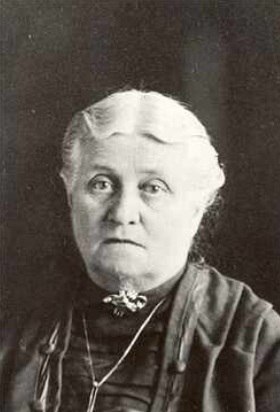
Anna Eliza Homer Lemon
By
EVA LEMON SHEEN
Anna Eliza, the fourth child of Russell K. and Eliza Williamson Homer, was born at Logan County, Illinois, March 19, 1843, during the period in which her parents were working their way westward. The story of her parents making their way from Pennsylvania to Iowa and their experiences, are set forth in greater detail in their own histories included in this volume, so it is not necessary to repeat them in this history. Anna was old enough to remember the trip her parents took from Iowa back to Pennsylvania in the year 1852 when her father went to settle the estate of his parents. One of the most vivid recollections of her childhood was their trip in a steamboat on Lake Erie on the return trip to Iowa. The travelling was done mostly by team in a new and open country through nature in the rough. On this same trip, she remembers an attempt to ford a stream when the water was high. Her father left the family on the bank to determine if the stream could be forded
safely. As he drove out into the water, the wagon box floated off downstream. He had to swim to shore, managing to save the horses and the running gear, but the wagon box was never recovered. His family was left on foot and on the wrong side of the stream.
This is but an example of the difficulties those pioneers often encountered, but they always managed to find a way out.
After her father began to freight goods across the Plains to Utah, she assisted her sister Nancy and her mother in keeping the hotel and general merchandise store at Crescent City, Iowa. Anna was growing into, young womanhood and she participated in many of the interesting experiences, entertaining the missionaries, emigrants, and Indians who stopped at their hotel.
She was 15 years old the summer the family came across the Plains. As her father was captain of the company, his family had to assume many responsibilities. Sometimes when they were short a teamster, she drove an ox team to help out, and was always required to be busy at some task, assisting with the work of getting the company across the Plains. There were quite a lot of congenial young people in the group. In the evenings they had good times, having programs and dances by the campfire.
Soon after their arrival in Salt Lake, she met and became interested in a young man, Willis Lemon, who lived with his parents on a farm at Mill Creek, just south of the city. The next fall, they joined with her sister Nancy and Martin Harris and another couple, Stephen White and Agnes McGregor, who were their mutual friends, and had a triple 1859 in the wedding. They were all married November l, 1859 in the old Endowment House in Salt Lake City. These young people were all very close friends, and they invited their host of friends to the wedding celebration, which was a memorable occasion.
Anna and her husband spent that winter in Salt Lake City. Early the next spring, they, together with Martin and Nancy Harris, undertook to help in the pioneering and building up of Cache Valley. They settled in Smithfield and built themselves a log house. Soon thereafter, her husband, Willis Lemon, and her brother-in-law, Martin Harris, Jr., were called by the L. D. S. Church to go back to Iowa to assist in bringing a train of emigrants across the Plains. This trip took about six months. During that time, an Indian uprising occurred, and some fighting took place.
Two of the town boys, the Merrill brothers, were shot; one of them died. All of this excitement occurring while her husband was away was certainly an unforgettable experience for Anna, particularly
because of the fact that she was expecting her first child during that time. Her eldest daughter, Anna Eliza, was born before her husband’s return.
During one Indian uprising, she and her sister Nancy ran for the fort. In the excitement, Nancy stumbled and dropped her baby in the creek. She recovered it, no worse for the experience except for a thorough wetting, so they all made to safety.
They lived the same type of pioneer life as is described in this volume in the histories of their parents and brothers and sisters. They carded and spun the wool and made their own candles and shoes.
One particular experience which remains vivid in the memory of the family is as follows: One evening she and her husband put the children ail to bed, put the light out, and went over to visit some neighbors. On their way home, they saw weird, flickering lights in the window of the house, causing them to think the house was on fire. They ran like mad, only to find that it was the children up having a good time. How thankful they were to find their family safe and sound!
Anna followed in the footsteps of her parents and maintained her interest in the Latter-day Saint church. She was a charter member of the Smithfield Relief Society, being very active in that organization all of the rest of her life. Outside of her religious interest, she was a real home woman, devoting her entire attention and energy to the welfare of her family. She was a kind and helpful neighbor and friend, always ready to help wherever there was sick- ness or bereavement. She died at Smithfield, July 6, 1911.
Her family was as follows
| Anna Eliza Lemmon | married Justin Abraham Knapp |
| Willis Lemmon, Jr. | died in infancy |
| Julia Caroline Lemmon | married George Abraham Hubbard |
| Nancy Matilda Lemmon | married Fred Albert Saurey |
| Eva Alvira Lemmon | married James Edwin Sheen, Jr. |
| Alice Lemon | married Axel Alfred Anderson |
| John Lee Lemmon | married Nellie Richardson |
| Rosette Lemmon | married William Francis Anderson |
| Nellie May Lemmon | married Henry Barnes |
| Hyrum Homer Lemmon | married Emma Hilda Anderson |

